History of the Multi-Organ Transplant Program
In 1972, University Hospital opened its doors and within six months surgeons had performed the hospital's first kidney transplant.
Researchers working with the LHSC Transplant Program began conducting test-tube experiments to manipulate the body's immune system and prevent organ rejection. In 1979, the drug company that discovered cyclosporine chose our hospital as one of the first centres worldwide to conduct a clinical study using this new anti-rejection medication. With the advent of cyclosporine, transplantation was on the rise.
In 1981, 14 months after the cyclosporine trials began, physicians noticed a significant decrease in organ rejection. The success of kidney transplants jumped from 50% to 80% survival one year after surgery.
London Health Sciences Centre added to kidney transplants with liver transplants (1977), heart transplants (1981), small bowel transplants (1988), and lung transplants (1989). The first bone marrow transplant at LHSC was performed in 1989 to treat a patient with leukemia.
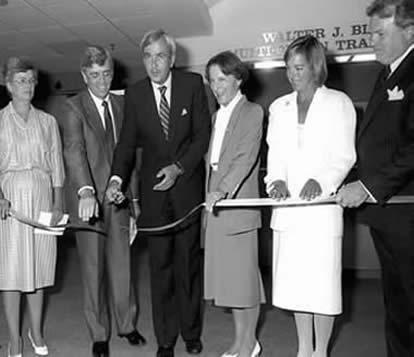
By 1987, our hospital had established itself internationally as a centre for multi-organ transplantation. The Ministry of Health recognized this status by granting funds to build the 12-bed Multi-Organ Transplant Unit.
The creation of the renowned Walter J. Blackburn Multi-Organ Transplant Unit -- the first of its kind in Canada -- was driven by the visionary work of Dr. Cal Stiller, the first director of the transplant program. The unit was named to honour philanthropist Walter Blackburn who served as president of the London Health Association from 1969 to 1973.
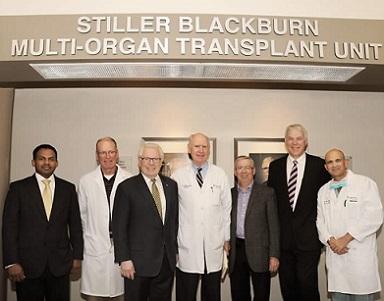
On September 17, 2014, the unit was renamed the Stiller Blackburn Multi-Organ Transplant Unit to recognize the contributions of Dr. Stiller, in partnership with the Blackburn family. At the event, Dr. Stiller said "This is a tremendous honour, to share the naming of this unit with the Blackburn family is extraordinary." He also highlighted his pride in the ongoing high donation rate that the London region continues to have -- comparable to the best donation rates worldwide -- as well as our innovative research.
Our longest-surviving kidney transplant recipient is celebrating more than 40 years of healthy life. Some of our earliest patients are Canada's longest surviving liver and heart transplant recipients, now celebrating 30 years of healthy life after their transplants in the early 1980s. When the 600th heart transplant was performed at LHSC in 2012, our centre had performed more heart transplants than any other centre in Canada.
Innovation has been a hallmark of our Multi-Organ Transplant Program. To address the shortage of donated organs, surgeons at LHSC have split livers from deceased donors into two halves so each half could be transplanted into separate recipients, suitably size-matched for the grafts. In 1993, a mother donated a piece of her liver so it could be transplanted into her infant son. Seven years later, in another Canadian first, that technique was extended to adult recipients by taking the larger right half of the liver from a living donor and transplanting it into an adult recipient.