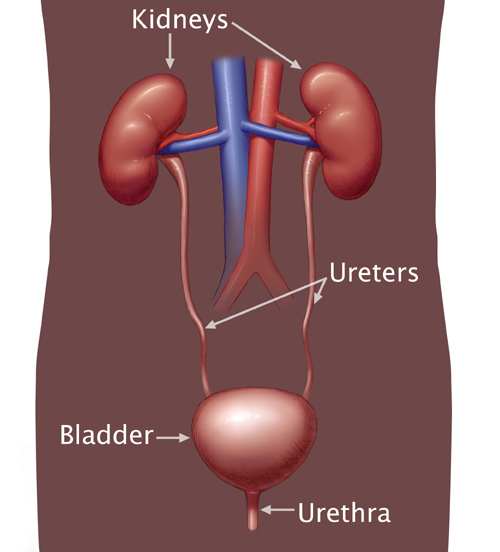
The kidneys are bean-shaped organs located near the back, just above the waist. Each kidney is about the size of a clenched fist and weighs about ¼ pound in an adult. Inside each kidney, blood moves through tiny filters called nephrons. There are about 1 million of these tiny filtering units in each kidney. Nephrons make it possible for two healthy kidneys to filter the body's entire blood supply every two minutes.
Kidneys perform several important functions:
- They regulate water. To function properly, your body must have the right amount of water. Kidneys remove excess amounts of water from the body or retain water when the body needs more.
- They produce hormones. These hormones circulate in the blood and regulate blood pressure, make red blood cells, and absorb calcium from the intestine.
- Healthy kidneys remove waste products. Minerals, such as potassium and sodium, are needed by the body's cells so they can function properly. These minerals must be kept at specific levels so the kidneys excrete excess amounts in urine. Calcium and phosphorous levels, important minerals needed for bone formation, are also regulated by the kidneys. Wastes, such as urea and creatinine, are made when the body breaks down protein, such as meat. Many waste products act like a poison if they are not removed from the body. With poor kidney function, waste products are not removed and the amount of creatinine and urea rises in the blood.
Adult Kidney Transplantation
Kidney failure occurs when the kidneys cannot perform their normal tasks. Kidney failure can happen slowly over time or very quickly (called acute renal failure). In some cases, acute renal failure is reversible. When kidney function is less than 10 per cent, the kidneys cannot remove excess water, salt, or wastes, and the body's tissues begin to swell. When wastes accumulate in the blood, people become seriously ill. Blood pressure starts to rise and, without medical help, kidney failure is life threatening.
The most common diseases leading to kidney failure include:
- glomerulonephritis
- diabetes
- polycystic kidney disease
- drug-induced kidney failure
- pyelonephritis
- urinary tract obstruction
- high blood pressure
Treatment for Kidney Failure
When kidney failure occurs, patients have some treatment options including dialysis at a hospital, dialysis at home, or kidney transplantation. Dialysis is a mechanical filtering process that cleanses the blood of waste products, removes excess fluids, and regulates body chemistry when the kidneys are not functioning properly. A successful kidney transplant is the preferred treatment for suitable patients with advanced kidney disease.
There are two types of kidney transplants – a living donor transplant or a deceased donor transplant, which uses a kidney from a person who has died suddenly. Most kidneys come from deceased donors although the ideal donor is a living donor because of the short time between retrieval and transplant. To find out more about living kidney donation, watch this video which features some of our donation and transplant staff as well as a living donor and her recipient talking about their experience. You can also read this brief step-by-step guide: The Living Donor Kidney Transplant Process. If you are considering approaching potential donors, you might find this guide helpful: Finding a Donor: Getting the Word Out.
Transplant Surgery
Transplant surgery usually takes three to four hours. The patient's own (native) kidneys are usually left in. Typically, they have become smaller in size which allows room for the new kidney.
The new kidney is placed in the lower abdomen where its artery and vein are connected to an artery and vein in the recipient. The ureter from the kidney is inserted into the recipient's bladder.
The recipient remains in hospital for seven or eight days. Education is given about the anti-rejection medications the patient will need to take for the life of the kidney to prevent rejection and how to care for their new kidney.
Quality of life
A successful kidney transplant results in improved health and freedom from dialysis, but transplantation is a treatment option and not a cure for kidney failure. Of the available treatment options, transplantation offers the best opportunity to be rehabilitated and to lead a normal lifestyle. The longest-surviving kidney transplant recipients worldwide are well 40 years after receiving a living-related kidney and 34 years after receiving a deceased kidney transplant. However, the average life of a transplant kidney from a living donor is 15-18 years and from a deceased donor 8-12 years.