LHSC was formed in 1995 upon the merger of University Hospital and Victoria Hospital. But our story began much earlier.
Our Proud Legacy
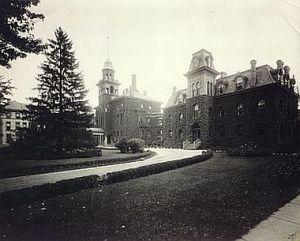
London General Hospital – 1875
The legacy of LHSC is more than 145 years old, dating from 1875, when the London General Hospital, opened on Ottoway Avenue, now South Street. The Honourable Donald Alexander Macdonald, Lieutenant-Governor of Ontario, officially opened the facility. Soon after, the hospital’s tradition of teaching and training was born. For more than a century, the citizens of London have made the availability and the advancement of comprehensive hospital services a topmost priority and a defining accomplishment of our community.
Clinical site for medical education - 1882
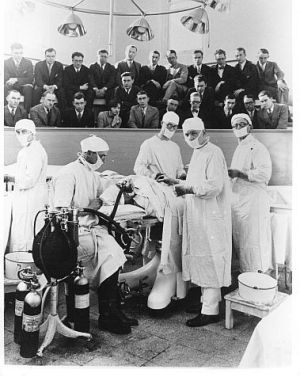
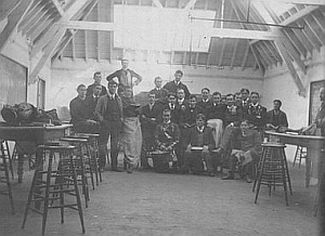
Our legacy as a teaching hospital dates from 1882, when the Faculty of Medicine of the Western University of London, Ontario (now The University of Western Ontario [UWO]), opened in a white frame cottage on St. James Street. By 1887, there were 60 students, too many for the original site, and a new building was constructed at Waterloo and York Streets. Change came in 1921, with the opening of a new building at South and Waterloo Streets, and in 1965, when the Faculty moved to the university campus. As London's first clinical site for medical education, the London General Hospital contributed to the development of the Faculty.
Canada’s third school of nursing established in London – 1883
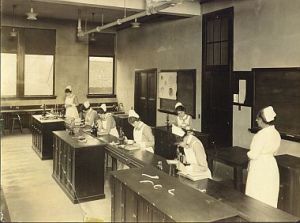
In 1883, the London General Training School for Nurses opened with three students enrolled—the third nursing school opened in Canada. Students lived in the hospital until the opening of the Nurses’ Residence in 1905. Nursing education in London transferred to Fanshawe College in 1975, and in 2001 became an integrated program of the College UWO.
Victoria Hospital gets its name – 1899
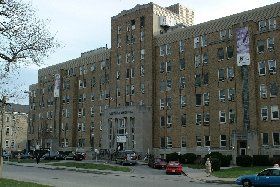
On November 16, 1899, some 15,000 Londoners jammed onto South Street to celebrate the opening of Victoria Hospital, an impressive new building that commemorated the 60th anniversary of Queen Victoria’s accession to the throne. Victoria Hospital filled almost an entire city block, and its distinctive bell tower instantly became a London landmark. In May 1941, an addition was opened to the north side of Victoria Hospital—the long-familiar South Street building façade.
Westminster Hospital joins Victoria Hospital - 1977
Begun in 1918 as a military hospital, Westminster Hospital was used to treat veterans suffering from mental illness after World War I. In 1929, Westminster Hospital received its name and also began to accommodate ex-service people who needed medical and surgical treatment. The hospital expanded during World War II to treat the sick and injured from nearby training camps. After the war, the focus returned to long-term and acute care for veterans with disabilities. In 1977, the hospital and its staff and patients were transferred to the Victoria Hospital Corporation, together with 80 acres of land, now LHSC’s new Victoria Hospital site at Commissioners Road and Wellington Road. In 1980, Parkwood Hospital assumed responsibility for the care of veterans.
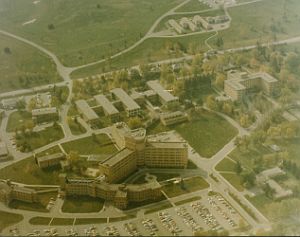
Origins of University Hospital – 1972
Tuberculosis was a serious health problem in Ontario prior to the development of antibiotics. Early in the 20th century, a group of prominent citizens led by Sir Adam Beck, Mayor and MPP, formed the London Health Association to create the Queen Alexandria Sanatorium (later renamed in honour of Beck), a privately run facility situated on a 130-acre farm near Byron. The facility was rededicated to other uses in 1972, when the sanatorium ceased operations, no longer needed to treat the disease. By then, the London Health Association had taken on a major new project—the development of University Hospital, which opened the same year. Dr. Wilder Penfield, the distinguished Montreal-based neurosurgeon, opened the new hospital, an affiliate of UWO, that September. University Hospital quickly established a reputation for medical advances in fields such as neurosurgery, cardiac surgery, and transplantation. Dr. Charles Drake achieved international renown for his innovative surgery for brain aneurysms, which attracted patients and surgeons from around the world to London.
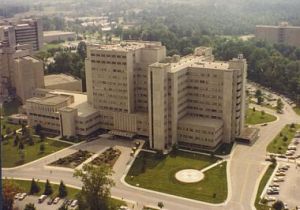
Celebrating 50 years of Care
Take a look back at the first 50 years of discovery and care at University Hospital in this special web section with feature stories and videos.
More than a century of children’s care – 1900, 1922, 1985
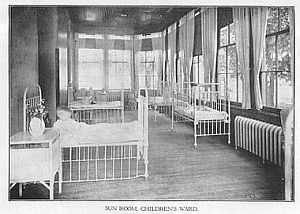
In May 1900, the Children’s Pavilion of Victoria Hospital opened, funded by the local branch of the National Council of Women. In October 1922, it was replaced by the War Memorial Children’s Hospital, which opened at the corner of South and Colborne Streets. The Imperial Order of the Daughters of the Empire spearheaded its development, with support from the Shriners, the Masonic Order, Women’s Institutes and other groups. The children’s hospital moved to Victoria Hospital’s Westminster site in 1985, becoming the Children’s Hospital of Western Ontario.
Chronology
1848: London's only hospital, known locally as the "framed" hospital, is built on a site in present-day Victoria Park.
1875: London General Hospital opens on Ottoway Avenue, now called South Street.
1881: The Medical Department of the Western University holds its first session.
1899: London General Hospital expands and changes its name to Victoria Hospital in honour of Queen Victoria.
1923 : War Memorial Children's Hospital opens.
1970: Affiliation agreement between University Hospital and The University of Western Ontario is announced.
1972: Official opening of University Hospital by Dr. Wilder Penfield.
1977: Victoria Hospital acquires Westminster Hospital and lands from the Federal Government and plans to redevelop the site.
1981: University Hospital becomes site of Canadian Centre for Transplant Studies.
1985: War Memorial Children's Hospital becomes Children's Hospital of Western Ontario.
1990: University Hospital takes over the management of the J.C. Kennedy Athletics Injuries Clinic.
1992: University Hospital, John P. Robarts Research Institute and Agriculture Canada create the Siebens-Drake Research Institute.
1995: The Board of Directors of Victoria Hospital and University Hospital unanimously approve the merger of the two hospitals.
1996: London Health Sciences Centre and Alexandra Hospital in Ingersoll form a strategic alliance, the first of such alliances.
1997: The provincial Health Services Restructuring Commission outlines a new mandate for London hospitals. This leads to city-wide alliances such as the Health Materials Management Services, Food Services and Labor Management Agreement.
2000: London Health Sciences Centre, St. Joseph's Health Care, London, Lawson Research Institute and LHSC Research, Inc. join forces to create Canada's third largest hospital-based research organization, the Lawson Health Research Institute.
London Health Sciences Centre and Lawson Health Research Institute establish the Canadian Surgical Technologies and Advanced Robotic (CSTAR) centre.
2002: Canadian Surgical Technologies & Advanced Robotics (CSTAR) and MD Robotics, maker of the world-renowned Canadarm, announce a partnership to develop the next generation of surgical robot.
Construction begins on the new 10-storey north tower at Victoria Campus, which will be home to the Children's Hospital of Western Ontario and Grace Donnelly Women's Health Pavilion.
2004: London Regional Cancer Centre integrates with LHSC to become the London Regional Cancer Program (now Verspeeten Family Care Centre)
LHSC transferred 102 acres of the Western Counties Property to the City of London to add to the Westminster Ponds Environmentally Sensitive Area (ESA). St. Joseph's Health Care London was allocated 50 acres for health-care and veterans park related purposes, and LHSC retained 100 acres for health and green space purposes.
2005: Site names of South Street Hospital (South Street location), University Hospital and Victoria Hospital (Commissioners Road at Wellington Road location) are adopted to better delineate the current location of hospital services for our community.
The emergency department for adults, and inpatient beds for critical care, medicine, surgery and cardiology patients, transfer from South Street Hospital to the new Victoria Hospital at Commissioners Road and Wellington Road.
2009: Construction completes on the exterior shell of the new north tower at Victoria Hospital.
2010: A number of clinical programs, including inpatient units, begin to occupy the new north tower (zone B) at Victoria Hospital. This marks a significant milestone in the citywide acute care restructuring project.
2013: The last of patient care services at South Street Hospital were transfered to Victoria Hospital, and the building was closed
2014: LHSC purchased the former Bethesda Centre at 54 Riverview Avenue as part of a proactive approach to extend care into the community. This site became the home for LHSC’s Adult Eating Disorders Service, a community-based program provided through a strong partnership between LHSC and the Canadian Mental Health Association (CMHA) Middlesex.
2015: The main South Street Hospital building was demolished and lands reverted back to the City of London. The original Colborne Building was left standing as a possible heritage site.
2018: The final phase of the decommissioning and demolition of the former South Street Hospital buildings on the north side of South St. was completed (excluding the Health Services Building and former War Memorial Children’s Hospital which were identified as possible heritage sites by the City of London).
Thames Talbot Land Trust (TTLT) in partnership with ReForest London (RFL) were selected as the preferred land transfer title holder for the remaining land and buildings on the Western Counties Property.