
At London Health Sciences Centre (LHSC), progress means finding new ways to reduce environmental impact while continuing to deliver high quality care. Across LHSC, teams are advancing practical and scalable solutions that support sustainability in everyday clinical practice, showing how small changes can lead to meaningful impact over time.
Reducing carbon emissions in surgery
In one significant project, the Operating Room Planetary Health Intervention Team (OR PHIT) is helping reduce LHSC’s carbon footprint through the Bring Your Own Reusables to Surgery initiative.
The program encourages patients to bring reusable bags to store clothing and personal belongings during surgery, as well as reusable water bottles. In the past, single use plastic bags and disposable cups were commonly provided. By shifting to reusable options, LHSC reduced carbon emissions by approximately 3,400 kilograms in one year, which is equivalent to driving across Canada twice.
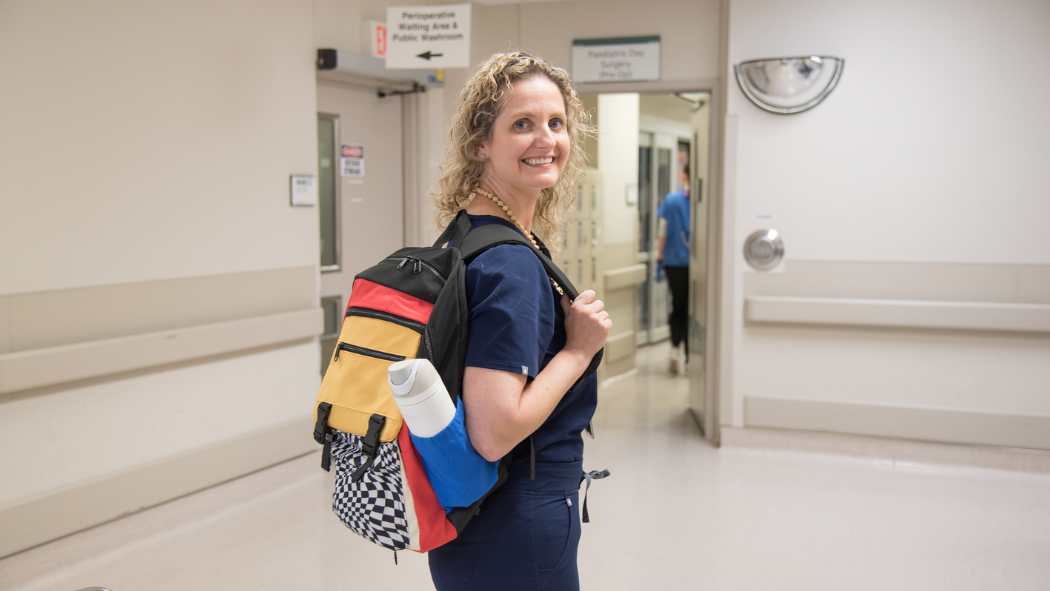
Led by Dr. Julie Strychowsky, a paediatric otolaryngologist at LHSC, the initiative was inspired by similar work at North York General Hospital and supported through the Ontario Surgical Quality Improvement Network’s Cut the Carbon campaign.
We found that over a year, more than 30,000 bags were given to patients having surgery at LHSC. Given this data, we saw this project as something that could have a big impact while remaining very manageable for staff and patients.
Dr. Julie Strychowsky, Paediatric Otolaryngologist at LHSC
Following a successful pilot at the Nazem Kadri Surgical Centre, the program expanded to University Hospital and Victoria Hospital, where adoption rates have continued to grow. The team is now exploring opportunities to extend the approach to other areas, including endoscopy and diagnostic imaging.
Giving medical supplies a second life through Second Chance Supplies
LHSC is also reducing waste and supporting global health through its Second Chance Supplies program, an initiative designed to keep usable medical supplies out of landfills and redirect them to health-care partners in need.
Led by the LHSC Green Team and Facilities Management, the program began as a pilot in the Neonatal Intensive Care Unit (NICU) at Children’s Hospital.
Due to Infection Prevention and Control requirements, many unused supplies brought into patient rooms must be discarded after discharge. Through this program, eligible items are now safely collected, sorted, and donated.
These types of initiatives directly support LHSC's environmental stewardship and operational efficiency.
Mike Apostol, Green Team Lead and Energy Management Specialist at LHSC
Frontline staff in the NICU play a key role in identifying and collecting supplies, which are then organized by the Green Team and distributed through partner organizations to clinics around the world. For example, shipments have reached health-care facilities in Cuba through partnerships with Not Just Tourists.
In addition to donations, LHSC Environmental Waste Specialists are using collected data to better understand which supplies are most frequently discarded, helping inform strategies to reduce waste at the source. The program is now expanding to additional clinical areas, with plans to increase both donation capacity and internal efficiency.
By giving supplies and equipment a second life, LHSC is reducing waste while supporting health systems beyond its walls, demonstrating how sustainability efforts can have both local and global impact.
Helping the planet, one inhaler at a time
Sustainability is also made stronger through partnership.
LHSC and St. Joseph’s Health Care London (St. Joseph’s) are working to reduce the environmental impact of respiratory care through the Go Zero Recycle program, which enables the safe collection and recycling of inhalers and aerochambers.
Prescription inhalers are essential for many patients living with asthma and chronic obstructive pulmonary disease (COPD), but certain types, particularly metered dose inhalers, rely on propellants that contribute to greenhouse gas emissions. In 2024 alone, more than 53,000 inhalers were dispensed across LHSC and St. Joseph’s, with a significant portion using these propellants.
To address this, drop off boxes have been introduced at respirology outpatient clinics, allowing patients to return used inhalers for proper recycling and propellant recovery.
We're not asking patients to stop using what works for them. But we want them to know there may be alternatives that are just as effective and have a lower environmental impact.
Dr. Constance Mackenzie, Respirologist at LHSC and St. Joseph's
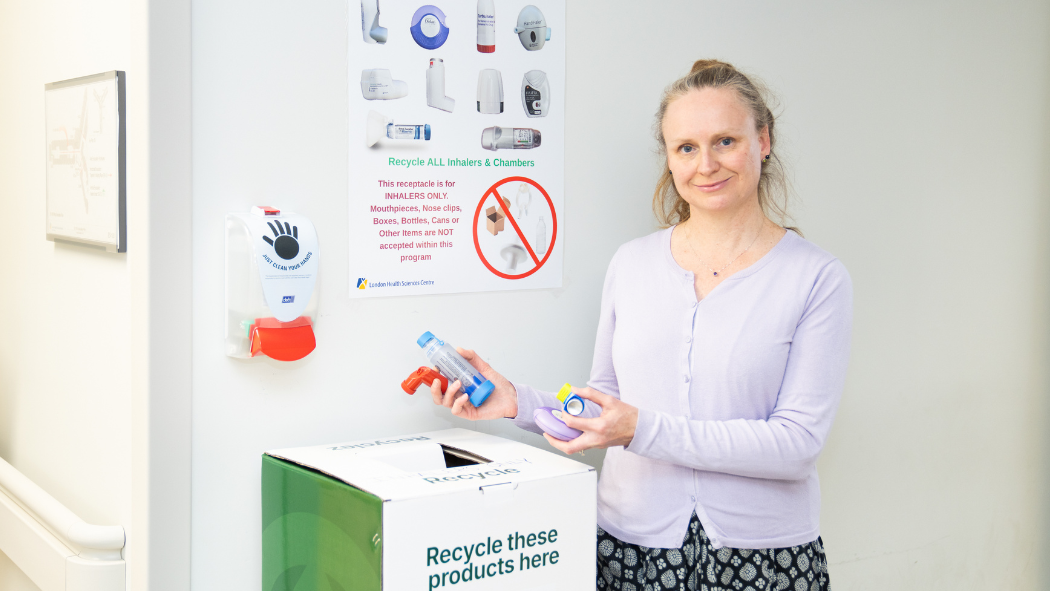
Clinicians are also supporting patients in exploring non propellant inhaler options, including dry powder and mist-based devices, where appropriate.
Inhalers are essential for many patients, but their environmental impact is often overlooked. By making recycling more accessible, we can make a real difference for both our patients and the planet.
Beth Jones, Registered Practical Nurse and Team Lead in the Respirology Clinic at LHSC
Together, these initiatives demonstrate how LHSC is taking practical steps today to reduce environmental impact and build meaningful progress toward a more sustainable future.