
At London Health Sciences Centre Research Institute (LHSCRI), researchers are continuing to advance patient care by achieving progress across a range of research areas. From rare disease research to innovation in cancer treatment and mental health, this collective progress reflects an ongoing commitment to discovery, collaboration, and innovation, bringing new knowledge closer to real-world applications and improving outcomes for patients and families.
Shriners Hospitals for Children Canada and LHSC launch landmark research program for rare childhood bone disorders
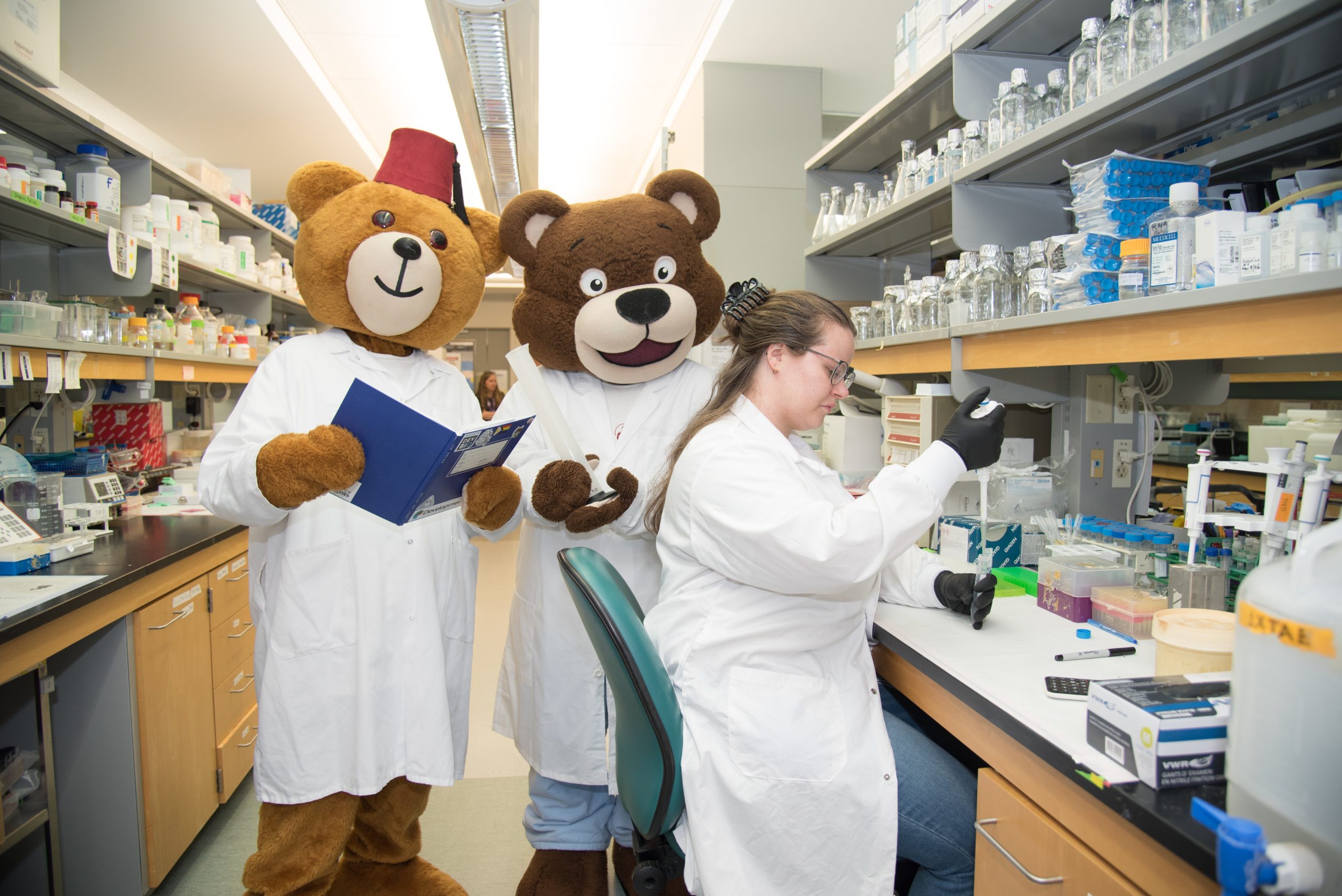
In one initiative, a growing partnership is focused on improving care for children with rare diseases.
One year after formalizing their affiliation, Shriners Hospitals for Children Canada and Children’s Hospital at London Health Sciences Centre (LHSC) launched the Skeletal Tracking to Accelerate Research (STAR) Program; a pan-Canadian research initiative targeting rare childhood bone disorders. Supported by a $400,000 research grant from Shriners Children’s and Children’s Health Foundation, the program will work to uncover the mechanisms behind rare bone diseases and to improve care for children across Canada.
Co-led by Dr. Leanne Ward (Children’s Hospital) and Dr. Frank Rauch (Shriners Hospitals for Children Canada), STAR is built on three pillars: the STAR Clinical Registry, a database to track and better understand the mechanisms and evolution of rare bone conditions in Canada; the STAR Demonstration Projects, which unite laboratory and patient-based research to explore new diagnostic methods and treatments; and the STAR Learning and Discovery Network, which facilitates ongoing collaboration, knowledge exchange, and training between the two institutions. Together, these efforts are designed to accelerate discovery while strengthening connections between research and clinical care.
Children's Hospital and Shriners Hospitals for Children Canada are both deeply committed to advancing paediatric health and this collaboration is a natural extension of that shared mission. Together, we can accelerate research that delivers better treatments, better outcomes, and brighter futures for young patients.
Dr. Craig Campbell, Department Head, Paediatrics at LHSC
‘Poop pills’ point to new possibilities in cancer care
Building on this spirit of collaboration and innovation, LHSCRI researchers are also exploring innovative approaches to cancer treatment. A team in London and Montreal has advanced a promising new approach to cancer care, with two studies published in Nature Medicine demonstrating the potential of fecal microbiota transplants (FMT) to improve treatment outcomes.
Conducted through a collaboration between LHSCRI, Lawson Research Institute of St. Joseph’s Health Care London (Lawson), and the Centre de recherche du Centre hospitalier de l’Université de Montréal (CRCHUM), the studies show that FMT can both reduce the toxic side effects of immunotherapy and enhance its effectiveness across multiple cancer types.
A Phase I trial conducted by scientists at LHSCRI and Lawson found that customized FMT may help reduce toxic side effects from an immunotherapy drug used to treat kidney cancer. Meanwhile, separate Phase II studies led by researchers at CRCHUM in collaboration with Lawson and LHSCRI demonstrated that, when FMT was added to treatment, patients with lung cancer and melanoma had improved response rates to their immunotherapy.
Both studies use advanced, world-leading FMT capsules, produced by Lawson. The capsules are processed from healthy donor stools and ingested to help restore a patient’s healthy gut microbiome.
Our hope is that our research will one day help people with cancer live longer while reducing the harmful side effects of treatment. We are world leaders in FMT research and we're excited about its potential.
Dr. Ricardo Fernandes, Scientist at LHSCRI and Medical Oncologist at LHSC
This research highlights the growing importance of the microbiome in cancer care and supports further pan-Canadian trials aimed at delivering more effective, personalized therapies. Together, these advances are helping redefine how cancer is treated, with a stronger focus on the patient’s overall health and response to therapies.
Enhancing survival through improved prostate cancer imaging
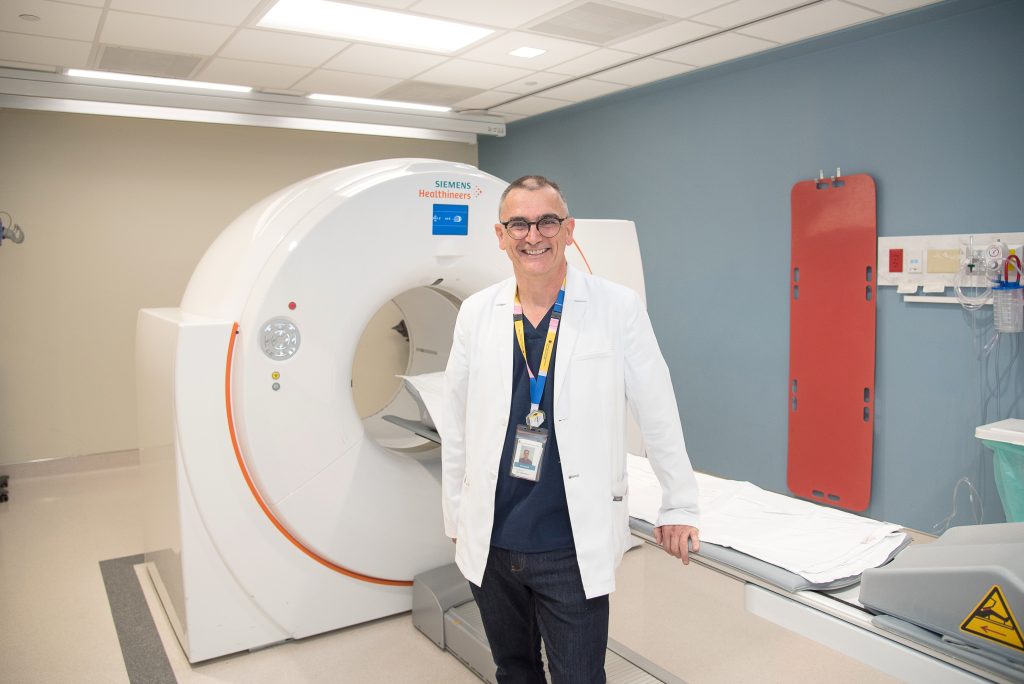
In parallel with advances in treatment, LHSCRI researchers are improving how cancer is detected and monitored. A multi-centre study led by LHSCRI, Lawson Research Institute, and University Health Network (UHN) has found a novel imaging solution, called prostate-specific membrane antigen (PSMA) positron emission tomography (PET) imaging, can more effectively detect the recurrence of prostate cancer compared to standard imaging methods, and is associated with improved survival outcomes. The study, which was carried out over seven years, is published in The Journal of Nuclear Medicine.
During a PSMA PET scan, a radioactive molecule designed to target a protein in prostate cancer cells is injected into the bloodstream of a patient prior to the scan. The study uncovered that the molecule is effective in binding to prostate cancer cells, helping to detect recurring prostate cancer earlier and more effectively than standard imaging.
The research team found that the overall detection rate was 70 per cent, much higher than the historical rate of detection of 10-20 per cent with conventional bone scans and CT scans. As a result of the scans, about half of all patients had their management of the disease changed.
This new technique gives physicians the information needed to determine the best treatment. When a blood test shows cancer has returned but standard imaging can't find it, physicians may need to use less precise therapies like whole-body drug therapy. With this new imaging technique, we can locate the cancer and target it directly.
Dr. Glenn Bauman, Scientist at LHSCRI and Radiation Oncologist at LHSC
Now funded as a standard of care in Ontario, this approach is enabling more personalized and effective treatment for men with advanced prostate cancer.
Exploring the potential biological connection between cannabis and mental health
LHSCRI researchers are also deepening their understanding of complex mental health challenges. A new study published in JAMA Psychiatry has identified a potential biological link between regular cannabis use and psychosis, adding important evidence to an evolving area of research.
Led by researchers at LHSCRI and Western University’s Schulich School of Medicine & Dentistry and using brain imaging techniques, the study found that individuals with cannabis use disorder, those who were using cannabis on a frequent basis over an extended period of time, exhibited signs of higher levels of dopamine in the same region of the brain that is tied to psychosis.
Dopamine is an important neurotransmitter that helps process motivation, mood, learning, and motor control. Excess levels of dopamine can disrupt normal brain processes and may increase the risk of psychosis, particularly in individuals who are already vulnerable.
We now have evidence that shows a straight line linking cannabis with dopamine and psychosis, that has never been shown before, and it's crucial that clinicians, patients, and families work together to break this line.
Dr. Lena Palaniyappan, adjunct professor at Schulich Medicine & Dentistry, former medical director for LHSC’s Prevention and Early Intervention Program for Psychosis (PEPP), and Senior Author
The findings may help explain clinical trends, including rising cases of cannabis-related psychosis seen in emergency departments. By identifying a biological link, the research underscores the importance of awareness, early intervention, and informed decision-making as cannabis use becomes more widespread.
Together, these advances reflect how research at LHSCRI is connecting discovery to real-world impact. Building on a strong foundation, this work highlights what is happening today while demonstrating the progress shaping the future of care.