
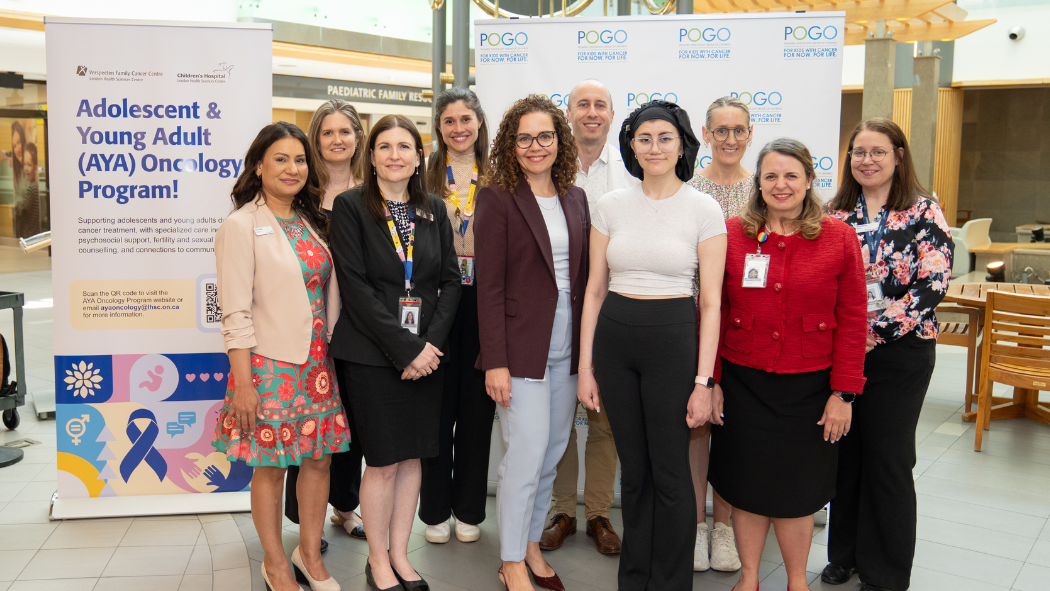
Left to right: Rajwant Sousa, Victoria Hagens, Carey Landry, Helen Protopapas, Dr. Marta Wilejto, Dr. Seth Climans, Ishtar Samano, Shannon Maier, Tammy Quigley, and Kyna Patterson.
June 4, 2026
As a 22-year-old student, cancer is the last thing on someone’s mind. For Ishtar Samano, this became a reality in 2025 when what began as unexplained backpain, soon led to emergency department visits, specialist appointments, and an overwhelming amount of uncertainty.
After months of worsening symptoms, Samano was diagnosed with stage four Hodgkins lymphoma.
"When I was initially diagnosed, I was faced with news that chemotherapy could affect my fertility," she recalls. "I felt that a future I had hoped for and dreamed of was thrown away in the blink of an eye."
Like many adolescents and young adults facing cancer, Samano's concerns weren’t just about her treatment. Not only was she dealing with a life-altering diagnosis, but she was also wondering how this would impact her education, her future and the possibility of one day having a family.
Recognizing the unique and often unmet needs of adolescents and young adults facing cancer, LHSC launched the Adolescent and Young Adult (AYA) Oncology Program one year ago.
About the AYA Oncology Program
Supported through funding from the Pediatric Oncology Group of Ontario (POGO), the program serves patients between the ages of 15 and 39, providing specialized support for fertility preservation, sexual health, mental health care and access to community resources. The program was developed under the leadership of Drs. Marta Wilejto and Andrew Arifin as a collaboration between the Verspeeten Family Cancer Centre and Children's Hospital at LHSC.
"This program creates a dedicated space for young patients to discuss concerns that are often unique to their stage of life," says Helen Protopapas, Clinical Nurse Specialist, AYA Oncology Program. "Whether it's fertility preservation, mental health supports, relationships, school or career goals, we're here to help patients navigate those challenges alongside their treatment."
How the AYA Oncology Program supports patients
For Samano, that support came at a critical moment.
After several rounds of chemotherapy did not work as hoped, she learned she would need a stem cell transplant. The treatment carried a high risk of infertility and early menopause. Before beginning the transplant process, she was referred to the AYA Oncology Program.
"At my very first appointment with AYA oncology, the clinical nurse specialist informed me of the two ways I could preserve my fertility," says Samano. "I remember leaving one of my first AYA appointments feeling lighter for the first time in months because someone finally understood the fears I was carrying."
Working closely with the AYA team and fertility specialists, Samano underwent ovarian tissue cryopreservation, helping keep open the possibility of having children in the future.
"For me, those options meant more than preserving fertility," she says. "They meant preserving a future I thought cancer had taken away."
The program also connected her with mental health resources, nutrition supports and opportunities to connect with other young adults facing cancer.
"AYA oncology was able to help me manage the mental and emotional aspects of my diagnosis," she says. "The nurses are young and understanding. In a way, it felt like I was talking to a friend rather than a nurse."
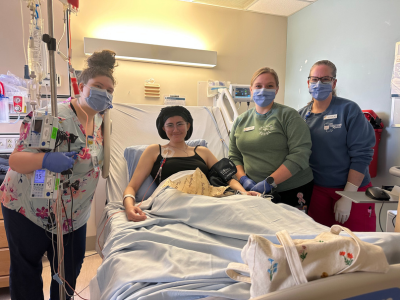
That experience resonates with 21-year-old Anthony Huang, another patient connected with the AYA Oncology Program.
Huang was approaching the end of his college program, preparing for graduation and looking forward to the summer. Instead, a routine follow-up appointment revealed an abnormal growth in his brain that would require further treatment.
"As young adults, we're just beginning to shape our future by starting careers, reaching new milestones and building momentum," he says. "When another brain tumour interrupted that, everything had to be put on pause. It felt like my future was being delayed or even taken away."
During treatment, Huang found support through the AYA Oncology Program and the people around him.
"It was mostly the people that I got to talk to that helped me the most," he says. "It provided me with the confidence to socialize with the people around me."
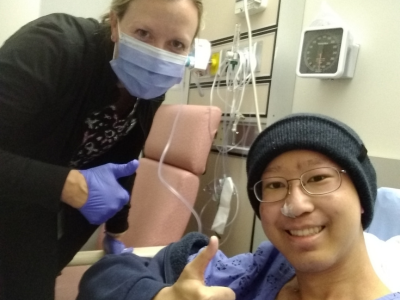
Today, both patients are focused on what comes next.
"Moving forward, I am hopeful for my future," she says. "This experience has made me appreciate the things I used to take for granted, no matter how big or small. I am looking forward to pursuing all the future goals I have for myself, no matter how long they take."
Samano achieved remission in December 2025 and underwent an autologous stem cell transplant in January 2026. Huang is exploring job opportunities in his field and working toward goals that were put on hold during treatment.
Reflecting on the first year of the program
As the AYA Oncology Program marks its first anniversary, stories like theirs show the difference that dedicated support can make for young people facing cancer.
"If I were to look back at each appointment I had with AYA oncology, what stands out the most was the way they were able to guide me through preserving my fertility after I had already received chemotherapy," says Samano. "Because of this program, I was able to secure a future I once thought would be taken away from me."
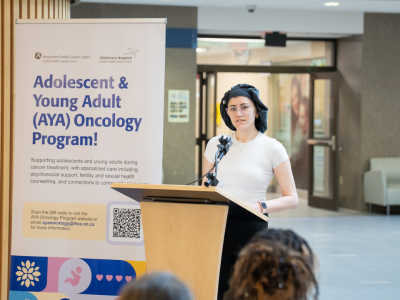
Although cancer changed their plans, both say the support they received helped them keep moving forward.
"It was mostly the people that I got to talk to that helped me the most," he says. "But losing my plans gave me something else in return: wisdom, patience and maturity. Through that process, I discovered strengths in myself that I didn't realize I had."
Samano agrees saying, "Cancer changed my life in ways I never expected, but the support I received reminded me that I was never facing it alone.”