
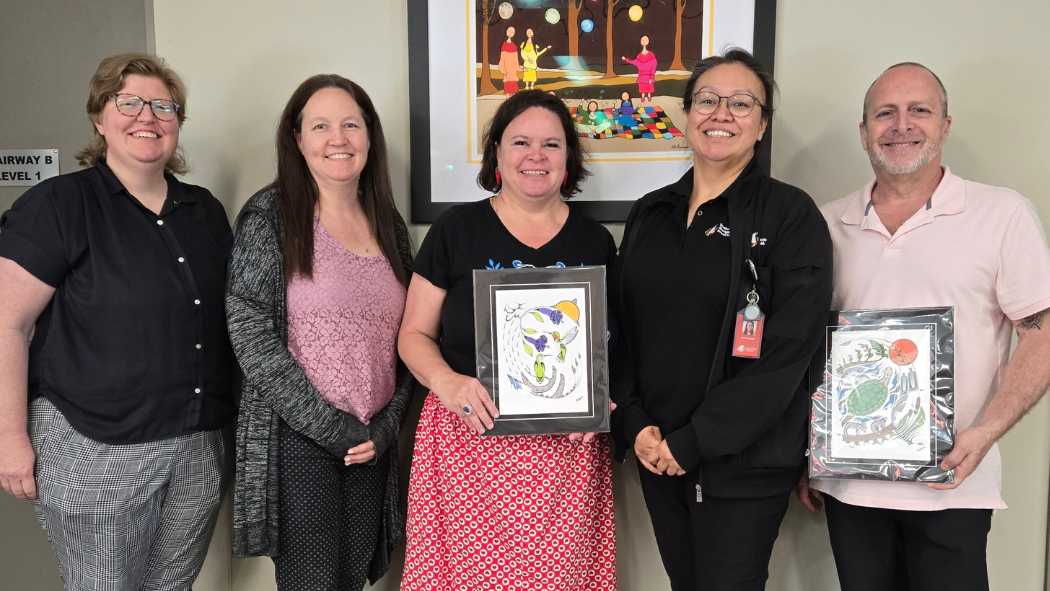
Image (from left to right): Jen Jones, LHSC Project Management Consultant; Rachel Sutherland, South West Regional Cancer Program Indigenous Patient Navigator; Mel Akiwenzie-Lisk, Indigenous Knowledge Keeper; Krista Doxtator, Indigenous Patient Navigator for Southwestern Ontario Aboriginal Health Access Centre; and Dr. Rob Di Cecco, physician. Photo credit: Lisa Jackson, Lisa Jackson, South West Regional Cander Program Indigenous Project Coordinator/Resource Consultant.
January 22, 2026
For many people, cervical cancer screening can feel uncomfortable, inconvenient, or out of reach. For Indigenous communities, those barriers are often compounded by long-standing inequities.
At London Health Sciences Centre (LHSC), clinicians and partners are working to change that reality by bringing screening, education, and culturally safe care directly into communities.
Through a growing partnership between LHSC and the South West Regional Cancer Program (SWRCP), Indigenous health partners, and community organizations, cervical cancer screening is becoming more accessible, more informed, and more grounded in trust.
Removing barriers to lifesaving screening
Cervical cancer is one of the most preventable cancers. It develops in the cells of the cervix and is most often caused by long-term infection with certain types of human papillomavirus (HPV), a very common virus spread through intimate skin-to-skin contact. While most HPV infections clear on their own, some can lead to abnormal cell changes that, over time, may develop into cancer. Cervical screening does not test for cancer itself, but detects HPV or early cell changes so they can be monitored or treated before cancer develops, making early detection a critical tool in preventing cervical cancer.
Yet, cervical screening rates across Ontario remain hovering around 60 per cent and are even lower among populations facing barriers such as limited access to primary care, transportation challenges, or past experiences of trauma.
“For many people, it’s not quite as simple as making an appointment,” says Dr. Robert Di Cecco, a physician within the Obstetrics and Gynecology department at LHSC. “For many folks, it is important to know who is providing the care, where it’s happening, and whether they feel physically and emotionally safe enough to come forward for screening.”
Pelvic exams can be particularly difficult for individuals with a history of sexual trauma or abuse. Others may feel uncomfortable being examined by a male physician or may not have a regular primary care provider at all.
To address these realities, Dr. Di Cecco and a team of colleagues at the SWRCP have focused on meeting people where they are – directly in their community.
The Indigenous Cancer Care team at SWRCP includes Dr. Samantha Boshart, Regional Indigenous Cancer Lead; Lisa Jackson, Indigenous Project Coordinator/Resource Consultant; and Rachel Sutherland, Indigenous Patient Navigator. Partners from LHSC's Project Management Office also support the team.
Community-based screening, led in partnership
Since 2021, LHSC has worked closely with Indigenous health partners, including Southwestern Ontario Aboriginal Health Access Centre (SOAHAC) and community organizations serving Chippewas of the Thames First Nation, Oneida Nation of the Thames, and Munsee-Delaware Nation, to deliver cervical cancer education and optional screening within community spaces.
Clinics are hosted in trusted locations and designed to be welcoming and culturally safe. Education sessions are paired with opportunities for screening, allowing participants to learn about cervical cancer and ask questions.
“Education always comes first,” says Lisa Jackson. “What we do is provide clear, respectful information so people can make informed decisions for themselves and their families.”
Traditional teachings around women’s health are woven into these sessions and SWRCP’s Indigenous Patient Navigator, Rachel Sutherland, is often present to support participants before and after the screening occurs.
“The environment matters,” Jackson says. “When people feel safe, supported, and respected, they’re much more likely to feel comfortable being screened.”
Building capacity within Indigenous health services
In addition to delivering care in the community, the SWRCP team is helping build long-term capacity by training nurses, nurse practitioners, and midwives within Indigenous health organizations to perform cervical screening.
Dr. Di Cecco leads hands-on workshops that cover both the technical and clinical aspects of screening, as well as approaches to trauma-informed and culturally safe care. Earlier this year, more than a dozen staff from SOAHAC and partner organizations completed HPV screening training, expanding local access to care.
“When screening can be done by someone you already know and trust, that removes another major barrier,” Dr. Di Cecco says. “It also means care doesn’t end when the pop-up clinic leaves.”
Prevention, not just detection
A key message shared during community education sessions is that cervical screening is not a test for cancer, but it is a tool to identify abnormal changes early, often long before cancer develops.
“When we catch changes early, treatment is usually simple and highly effective,” Dr. Di Cecco explains. “In most cases, it doesn’t affect fertility or the ability to have children later in life. That’s a powerful reassurance for many people.”
The work also emphasizes the role of the HPV vaccine, which has been shown to dramatically reduce the risk of cervical cancer. Globally, the World Health Organization has identified cervical cancer as a disease that could be eliminated through a combination of vaccination and screening. Locally, the goal is equally ambitious.
“Every screening matters,” Jackson says. “Even if five people come forward, that’s five people who now have information, support, and a better chance at early intervention.”
Small steps create lasting impact
Feedback from participants has been overwhelmingly positive, with many returning for subsequent screening events and encouraging family members to attend. In some cases, multiple generations have participated in education sessions together, planting the seeds for prevention well into the future.
“Cervical cancer doesn’t just affect one person,” Dr. Di Cecco says. “It affects families, partners, and entire communities. The fact that we can prevent much of that harm is what keeps us going.”