
March 16, 2026
On any given day in the London Health Sciences Centre (LHSC) Emergency Departments, Dr. Danielle Kelton is accustomed to the unexpected. As an emergency physician, she regularly navigates fast-paced, high-stakes situations where quick decisions and teamwork are essential.
Those same skills now travel with her far beyond the hospital walls.
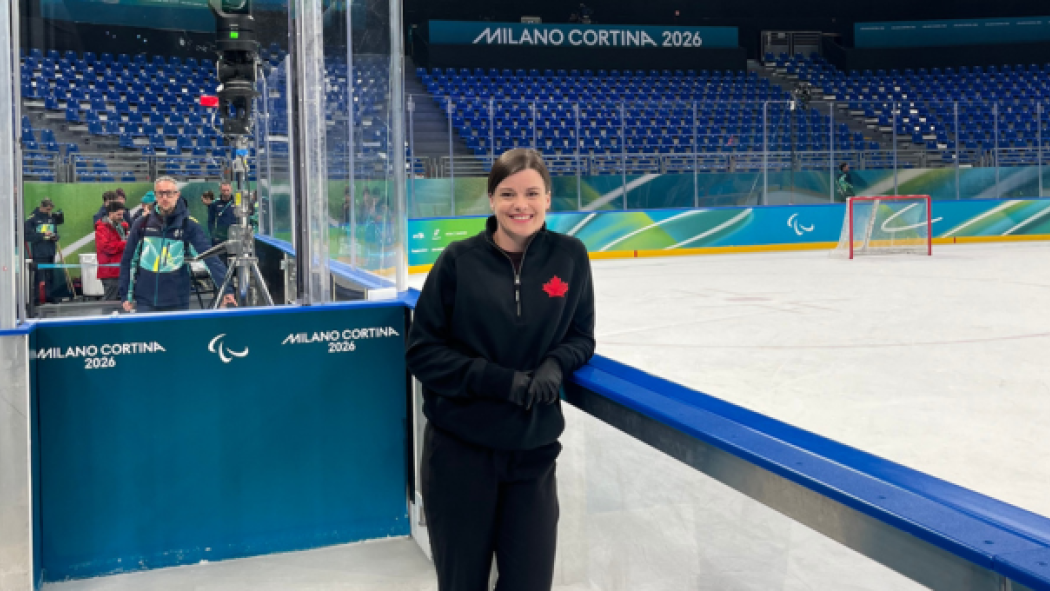
This winter, Dr. Kelton is serving on the international stage as part of Team Canada’s medical staff at the Paralympic Games in Milano-Cortina, where she is the lead team physician for Canada’s National Para Ice Hockey Team. A member of the Canadian Paralympic Committee mission staff, she has spent the past several weeks travelling with the team as they prepared for the 2026 Games, supporting athletes through training, competition, and recovery.
Dr. Kelton’s work is intense, meticulous, and deeply collaborative, with game days being especially busy. Mornings often begin with activation sessions – chair yoga, mobility exercises, or light cardio – to help athletes prepare their bodies for competition. Later in the day, Dr. Kelton and the team physiotherapists hold dedicated clinic hours in the Paralympic Village to assess injuries and address medical concerns.
By the time the team arrives at the arena for evening games, the medical staff are already preparing the bench and dressing room with a full suite of medical equipment and medications. During warmups and gameplay, Dr. Kelton remains close to the bench, ready to respond to injuries or emergencies at a moment’s notice. Between periods she checks in on athletes managing ongoing conditions or heavy playing time, and after the game she supports injury care, recovery and, when required, accompanies athletes through doping control.
“Hockey is a team sport, and hockey sport medicine is too,” she explains. “Our support staff is small, so everyone pitches in. Sometimes that even means helping the equipment managers or strength coach with whatever needs doing.”
The role carries unique complexity in para sport. Each athlete on the team competes with a physical impairment, as defined by World Para Ice Hockey, that qualifies them for para ice hockey, and every player brings distinct medical considerations.
“Para hockey players are unbelievable athletes, both mentally and physically,” says Dr. Kelton. “The strength required to play this sport at an elite level is extraordinary. What makes the medical care unique is that every athlete’s circumstances are different, so we have to individualize the way we support them.”
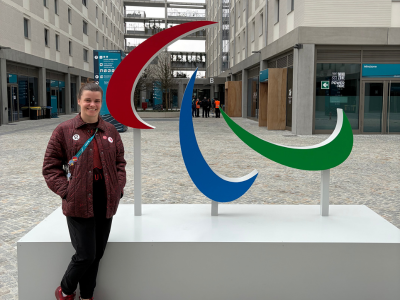
Above: Dr. Kelton stands in front of the Agitos (symbol of the Paralympic movement).
Over the past four years working with the team and Hockey Canada, Dr. Kelton has come to know each athlete’s story, medical history, and training journey. That continuity of care is supported by an integrated national team that includes physiotherapists, athletic therapists, dietitians, strength and conditioning coaches, psychologists, and mental performance specialists, all of whom collaborate virtually when they are spread across the country.
While the stakes of international competition are high, Dr. Kelton says one principle always guides decision-making: the long-term health of the athletes.
“These Games are something athletes work toward for years, so helping them safely return to play while protecting their long-term wellbeing can be a delicate balance,” she says. “Ultimately, no game or tournament is more important than the health of the athlete.”
For Dr. Kelton, the experience is both professionally rewarding and personally meaningful. Working closely with the athletes has offered daily lessons in resilience, perseverance, and purpose.
“The athletes I work with are some of the best humans I know,” she says. “Each one has their own story of adversity and perseverance. Watching the joy they find in pursuing their goals and working hard as a team reminds me that there can be real fulfillment in that kind of dedication.”
Those lessons, she says, follow her home to London.
The fast-paced environment of elite sport mirrors many of the same demands Dr. Kelton encounters in the Emergency Department – rapid decision-making, managing intense emotions, and working closely with a team to deliver the best possible care.
“Learning to stay calm in chaos and make decisions with limited information are skills that translate directly between the hospital and the sport environment,” she says.
When she returns to LHSC, Dr. Kelton brings those experiences and the inspiration of the athletes she supports back to her daily work with patients.
“No matter where I am practicing, I try to bring the same passion and commitment to excellence,” says Kelton. “The teamwork, communication, and collaboration I practice in sport ultimately make me a better doctor at home.”
In a country where hockey is deeply woven into the national identity, being part of the sport on the international stage carries special meaning for Dr. Kelton.
“Growing up in Canada, it is hard to overstate how important hockey is to Canadians. It is a core identity for many and a rallying point for our national pride in many ways,” she says. “It is exciting and always a privilege to wear the Maple Leaf on an international stage and represent the best things about Canada – resilience in the face of adversity, respect for others, and acceptance of people from all backgrounds. Our para hockey athletes exemplify the best of our Canadian values and it is the privilege of my lifetime to support them on their Paralympic journey.”
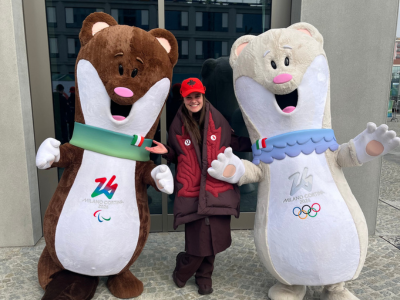
Above: Dr. Kelton poses with Milano-Cortina Olympic and Paralympic mascots, Milo and Tina.