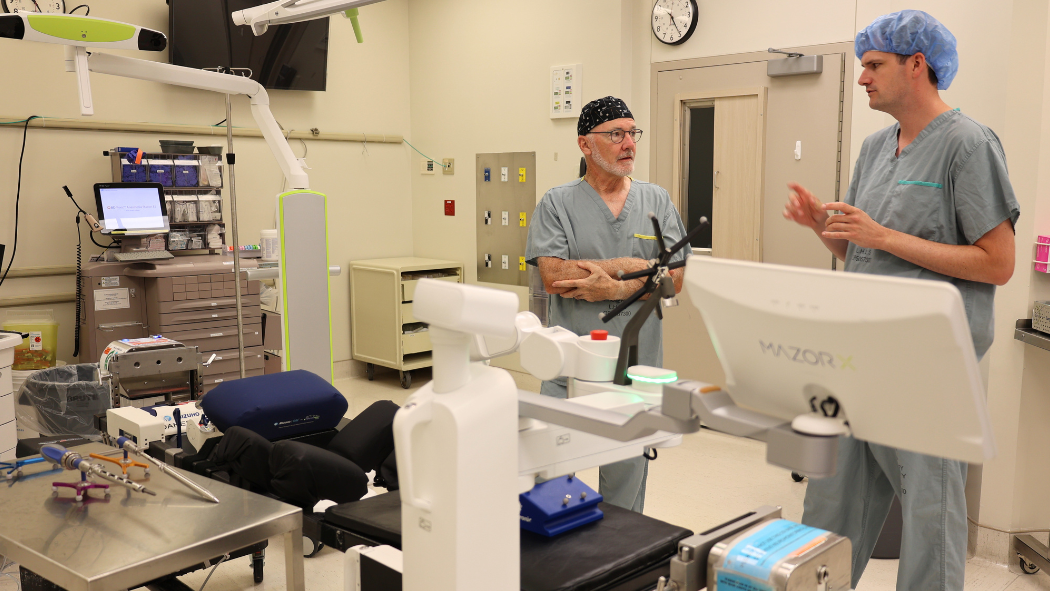
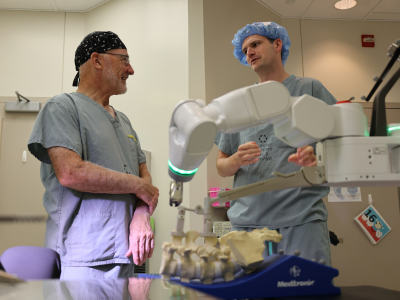
Dr. Timothy Carey and Dr. Patrick Thornley, Paediatric Orthopaedic Surgeons at Children's Hospital at London Health Sciences Centre (LHSC) pictured with a Mazor Robotic System.
August 13, 2026
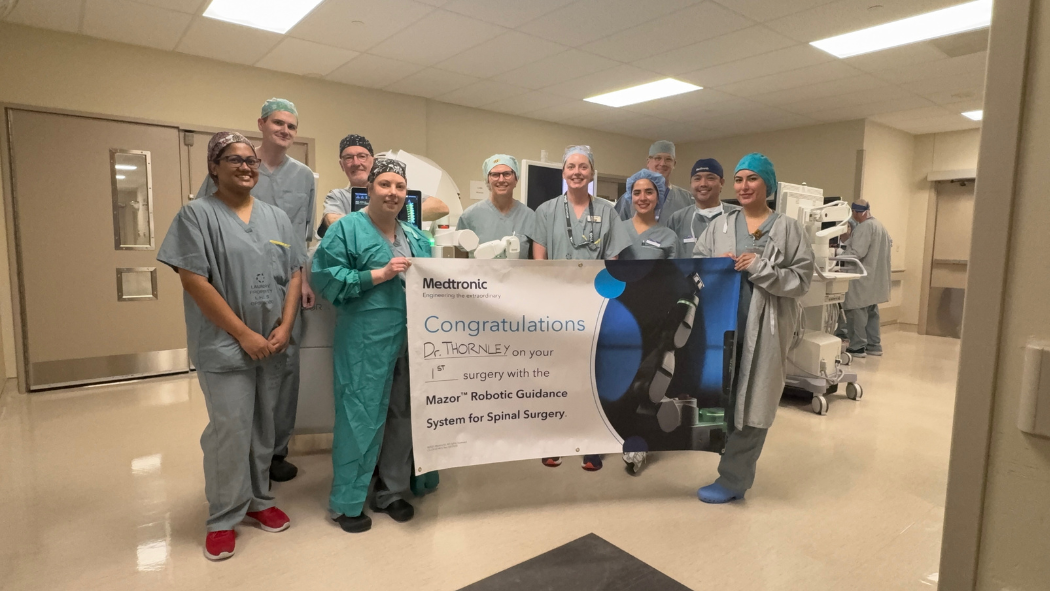
Children's Hospital at London Health Sciences Centre (LHSC) has achieved a major milestone in surgical innovation, becoming the first hospital in Ontario to use the Medtronic Mazor robotic spine platform for a paediatric scoliosis correction.

Mazor features software that allows surgeons to upload their patients’ imaging in order to plan their procedures ahead of time and then
action them in the operating room (OR). The system has three arms: a robotic arm that assists with the procedure, one that performs CT scans and another that takes X-rays, giving care teams access to the latest imaging right in the OR.
Fourteen-year-old Paige Hillman first started complaining about back pain last summer. Not long after, her mother Melissa spotted the telltale signs of scoliosis, a condition she also has.
“I could see the curve in Paige’s back. It was like her whole body was curving to the spine, even her shoulders,” Melissa says. “You could see it when she was walking and when she was wearing tighter clothes.”
Given her first-hand knowledge of how painful a scoliosis spinal malformation can be, Melissa didn’t want the same fate for her daughter.
“As I get older, I’m in more pain than I used to be with a lot of pain in my lower back and up in my neck area,” Melissa says. “I just didn’t want her to feel like that. I wanted her to grow up and have fun.”
Melissa called their family physician in Windsor, who then referred Paige to Children’s Hospital.
Dr. Patrick Thornley, Paediatric Orthopaedic Surgeon, and his colleagues worked with Paige and her family to come up with a plan to address her scoliosis. Knowing the Hillmans were open to surgical intervention, they asked if they would be interested in having the robotic Mazor platform used during Paige’s procedure. Up until that point, the system had only been used on adults at LHSC.
After conversations with the care team, the Hillmans said yes and in March 2026 Paige became the first paediatric patient in the province to undergo a scoliosis correction using Mazor.
Elevating care through innovation
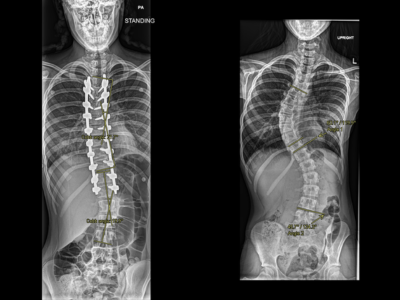
Using images of Paige’s spine taken during low-dose radiation CT scans, Dr. Thornley and the care team used the Mazor planning software to map out Paige’s entire procedure ahead of time and design the surgical plan.
That plan was then uploaded directly onto the robotic platform in the operating room (OR) where they took X-rays to confirm Paige’s positioning, all of which enabled real-time visualization that supported Dr. Thornley through the procedure.
Dr. Thornley opted to use the robot to place the most challenging screws in Paige’s spine, reducing the time it would usually take to accomplish that task from roughly 20 minutes manually down to about three. The actual spinal correction took a little less than four hours to complete, with Paige’s dedicated care team spending about eight hours in total with her in the OR.
Paige’s positive outcome
The procedure was a success resulting in a near-perfect result with Paige even gaining a couple of inches in height thanks to the spine correction. She was able to go home to Windsor after just a few days in hospital and returned to school after roughly four weeks, instead of the expected six.
Most importantly, her quality of life has greatly improved.
“My back would hurt most of the time before the surgery and even more when I would lie down,” Paige says. “Now it barely hurts. It’s really nice.”
As for how it makes her feel to know her surgery was the first such case in Ontario, Paige doesn’t hold back.
“It feels amazing. Sometimes I like to brag to my friends about it,” she says with a chuckle.
"Performing the corrective surgery now rather than when Paige reached adulthood will greatly reduce her chances of further issues and ensure she’ll have a much healthier spine moving forward,” says Dr. Thornley.
“The risk of progressive deformity has been removed by this surgery,” he says. “It’s everything we could hope for at least in the early stages.”
“I feel proud of Paige as a patient, I think she’s done a great job.”
The role of robotics in the future
Paige’s positive experience is a testament to Children’s Hospital’s commitment to innovation and investment in the latest technologies. Both the University Hospital as well as the Victoria Hospital and Children’s Hospital sites now operate their own Mazor robotic platforms, and to date, surgeons across LHSC have performed 10 to 15 procedures using the platform, across a range of patient ages and conditions. The costs associated with both robotic platforms are supported through provincial funding.
Robotic‑assisted surgery is transforming operating rooms worldwide, but uptake across Canada remains varied. LHSC has long been a leader in the field, recognizing the potential for improving patient care.
“The strength of Mazor and other spine robotic platforms, will ultimately be that we're going to see increased accuracy, increased safety, better outcomes, and safer, faster surgeries for kids and adults,” says Dr. Thornley. “That's the whole point of why we want to use it.”