
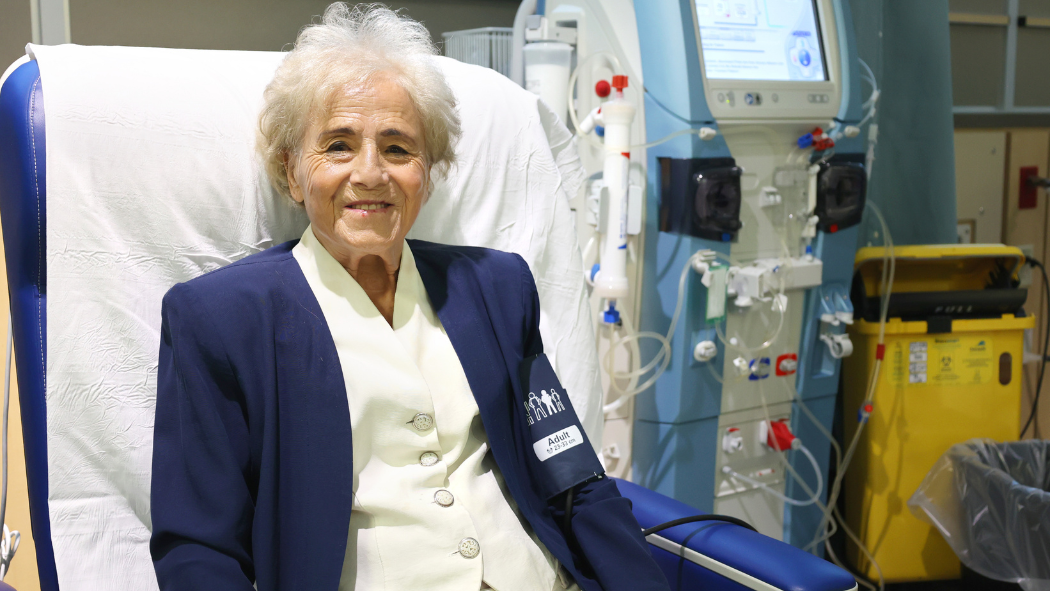
Photo: Maria Medeiros getting prepared for her dialysis appointment at the Westmount Hemodialysis Unit
September 17, 2026
Thirty-seven years ago, in 1989, music artists like Chicago, Paula Abdul, and Bette Midler were topping the charts (and future chart topper Taylor Swift was born). Movies such as Indiana Jones and the Last Crusade, Back to the Future Part II, and The Little Mermaid were bringing in huge audiences to theatres and only about 1.5 per cent of the Canadian population had a cell phone.
Technology looked a lot different. You had an actual camera to take photos, a paper map for directions, and a Walkman to play music on-the-go.
What else happened thirty-seven years ago? Maria Medeiros started dialysis.
Maria's experience in the Renal Program
Maria was diagnosed with polycystic kidney disease (PKD) in the 1980s. PKD is an inherited disorder that causes fluid-filled cysts to grow in the kidneys.
"I was diagnosed with PKD a number of years before I started dialysis through blood work," Maria explains. "But it reached a point where my kidneys were not functioning properly anymore and I needed to start dialysis. I started my dialysis at the old Victoria Hospital in 1989 and went there for one year before going to Base Line Road when they had the dialysis centre. Now I go to Westmount as they transferred the program there."
Over the 37 years, Maria has also been the recipient of three kidney transplants, but unfortunately, they did not take. She became quite sick after her transplants and even ended up in intensive care.
"I am the only person in my family with polycystic kidney disease - none of my siblings have this. And when I started dialysis, I already had three children," shares Maria. "When my family was being tested as possible kidney donors, my siblings were not a match, but my daughter, who was 17 years old at the time, was. However, she was too young to donate, so I had to move forward with unrelated donors."
Maria notes the difficulties she experienced balancing raising three small children (the oldest was 10 years old when she started dialysis) and going to dialysis treatment in- centre three times a week. She shares that her social worker at that time helped her with balance when she was starting dialysis.
All of Maria's original care team members have left or retired, but she remains grateful for everyone's excellent care over the decades.
Maria says that "Dialysis has felt like a family where the team made it feel less medical. The staff have been great and always accommodate whatever I need. I like to make food, especially around Christmas, and bring it in for staff because I know they always do their best."
While having to go into the clinic three times a week for dialysis has been taxing in some ways, Maria is grateful for her care and hopes for many more years to spend with family.
"My children and I are close, and I have a granddaughter now. It's been a pleasure to see my children grow up and to meet my grandchild," Maria says.
Dialysis care over the decades
"I've been a nurse practitioner for almost three decades," says JulieAnn Lawrence, Nurse Practitioner, Westmount Hemodialysis Unit, London Health Sciences Centre (LHSC). "And while it's not frequent that I continue to care for patients from when I began, I've had about five of my patients approach the 30-year mark in their dialysis treatment."
Lawrence emphasizes the patient's strict adherence to the many lifestyle restrictions that come with kidney disease.
"Restrictions in diet, managing medications, keeping to dialysis schedules, attention to small deviations in their health status require an intense amount of energy, dedication, and resilience to incorporate in their everyday life," Lawrence explains. "That helps provide longevity, but people living with kidney disease have their own journey. Over the past decades there have been improvements to primary care support for the management of kidney disease, advancement in transplantation and immunosuppressive medication, as well as innovations and improvements in various dialysis modalities that not only extend life but enhance the quality of life."
Thanks to advancements and improvements in funding and the model of care, more recently, patients are treated holistically in the early stages of kidney disease to slow or reverse progression. Lawrence shares that this means that when patients end up needing dialysis, they will have support along the way as they participate in decisions around the treatment that suits their experience and care pathways that enhance patient outcomes.
Lawrence says, "There are still many kidney diseases that are related to autoimmune disorders and genetic conditions, such as Maria's polycystic kidney disease, and as more inheritable conditions are identified, there will hopefully be early surveillance and intervention opportunities in the future so those future generations may not need dialysis or transplantation."
A lot has changed in 37 years in dialysis, and Lawrence notes that improvements in access and the therapies themselves have helped give people more years to their life, and life to their years.
"Thankfully, now with regional hemodialysis programs, optimization of home therapies such as home hemodialysis and peritoneal dialysis, as well as the introduction and improvements made to virtual care – more patients are able to access dialysis and enjoy a reasonable quality of life," Lawrence shares.