
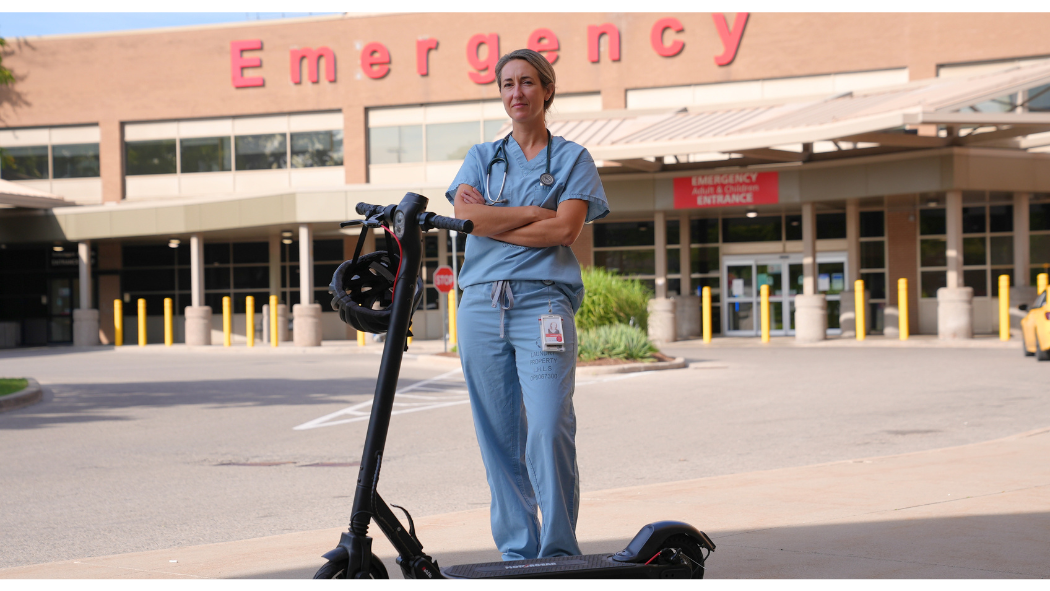
Dr. Sheena Belisle, Paediatric Emergency Medicine Physician at LHSC.
August 28, 2026
E-scooters have become a common sight zooming around neighbourhoods and city roads. For many riders, they offer a fun and convenient way to get around, but over the course of the spring and summer months, emergency physicians at Children's Hospital at London Health Sciences Centre (LHSC) have noted an alarming increase in the number of patients seeking care for injuries related to unsafe riding.
Between April and June of 2025, Children's Hospital treated approximately 22 injuries related to incidents involving e-scooters. During the same time period in 2026, that number has increased to 58, a 164 per cent increase. Physicians believe that trend has continued through the summer months.
Dr. Sheena Belisle, Paediatric Emergency Medicine Physician and Assistant Professor for the Department of Paediatrics at Schulich School of Medicine and Dentistry at Western University, says she and her colleagues are growing more concerned as the number and severity of injuries continues to climb, with many of them preventable.
"We've definitely seen an increase in the number of children and teens coming to the emergency department with e-scooter-related injuries," says Belisle. "While some injuries are relatively minor, we're also seeing patients with broken bones, significant cuts, facial injuries and concussions. What's particularly concerning is that many of these injuries involve children who are younger than the legal riding age. When we see a child seriously injured on an e-scooter, it often means the crash should never have had the opportunity to happen in the first place.”
Some patients are lucky with their tumbles only leading to cuts and bruises that heal relatively quickly. However, other injuries are so severe that they require surgery and lead to recoveries that stretch for weeks or even months, putting a significant damper on summer fun.
"The injuries that concern me the most are head injuries. My main concern is the potential for intercranial bleeds which can be life threatening or life altering," Belisle explains. "Even concussions can have long term consequences as they are more at risk for future concussions and it can take them longer to return to regular activities and routines."
Dr. Belisle hopes that by sharing the impact these injuries can have on children and families, more people will understand the importance of following safety rules and taking steps to prevent serious injuries.
"Many of the injuries we see share common factors. Riders may not be wearing helmets, there may have been more than one person on the scooter, or they are riding distracted."
Belisle also comments that families are often surprised that some of the most serious injuries occur during short, routine rides close to home.
"The length of the ride isn't what determines the risk. What matters is whether a child has the physical coordination, judgement and awareness needed to safely operate the scooter and respond to what's happening around them," says Belisle also noting the importance of following provincial regulations which prohibit children under the age of 16 from riding the devices. To help address the growing number of injuries, LHSC has partnered with community organizations including London Police Service, the City of London, the Middlesex-London Health Unit and Western University to raise awareness about e-scooter safety and local bylaws.
Throughout the summer, medical students from Western University’s Schulich School of Medicine & Dentistry engaged with community members to better understand what residents know about e-scooter safety and regulations. Their findings helped inform the safety messages being shared by Belisle and her colleagues.
Belisle encourages families to have ongoing conversations about road safety and responsible e-scooter use, particularly around the importance of wearing a helmet and following local regulations. More importantly, she wants families to know that if an injury does occur, they should never hesitate to seek medical care.
"We would always rather someone come in to get checked if they're worried about an injury," says Belisle.
For Belisle, the message is ultimately a simple one. "E-scooters are not toys. Our goal isn't to take the fun away from riding them, but to help children and families stay safe. If sharing what we're seeing in the emergency department helps prevent even one serious injury, then these conversations are worth having."
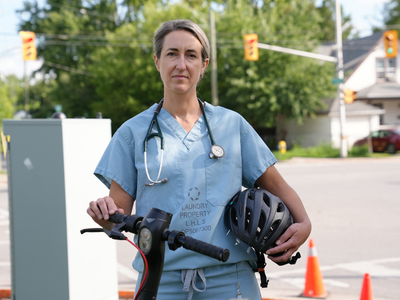
Myths vs Realities
In an effort to inform the general public and families about E-scooter safety, Dr. Belisle has provided some additional information surrounding misconceptions and common questions she’s asked as patients and their families come into the Emergency Department.
Myth: "They're just toys."
Reality: These are motorized vehicles capable of causing significant injuries. According to the City of London, the speed limit for E-scooters is set at 24 km/hr and they should only be ridden on roadways posted at 50 km/hr or less, in bike lanes, and on multi-use pathways.
Myth: "I don't need a helmet for a short trip."
Reality: Many serious injuries occur close to home and during leisure rides. Helmets help protect against serious head and brain injuries and should be worn every time you ride, regardless of the distance. Riders aged 16 or 17 must wear a helmet when using an electric kick-scooter, and no one under the age of 16 should be riding an E-scooter.
Myth: "It's okay if my child just rides for a few minutes."
Reality: Length of time isn't what determines risk. Children need physical coordination, judgment, and awareness to safely operate an e-scooter and react to traffic, pedestrians, and obstacles. Age restrictions are in place for a reason, and younger riders may not yet have the skills needed to safely navigate unexpected situations. As per the City of London bylaw, parents are responsible for ensuring their child under the age of 16 does not ride an e-scooter.
Myth: "One extra rider isn't a big deal."
Reality: E-scooters are designed for one rider. Adding a second passenger changes the scooter's balance, steering and braking ability, making it much harder to control. Multiple riders increase the likelihood of a crash and can lead to more serious injuries when a fall occurs. As part of the provincial regulations, no individual operating an E-scooter is allowed to carry any additional people.
Myth: "Most e-scooter injuries are just scrapes and bruises."
Reality: While some riders walk away with minor injuries, emergency physicians are also seeing fractured bones, significant facial injuries, and head trauma. What starts as a fun ride can quickly become an emergency department visit, making prevention and safe riding practices critical.