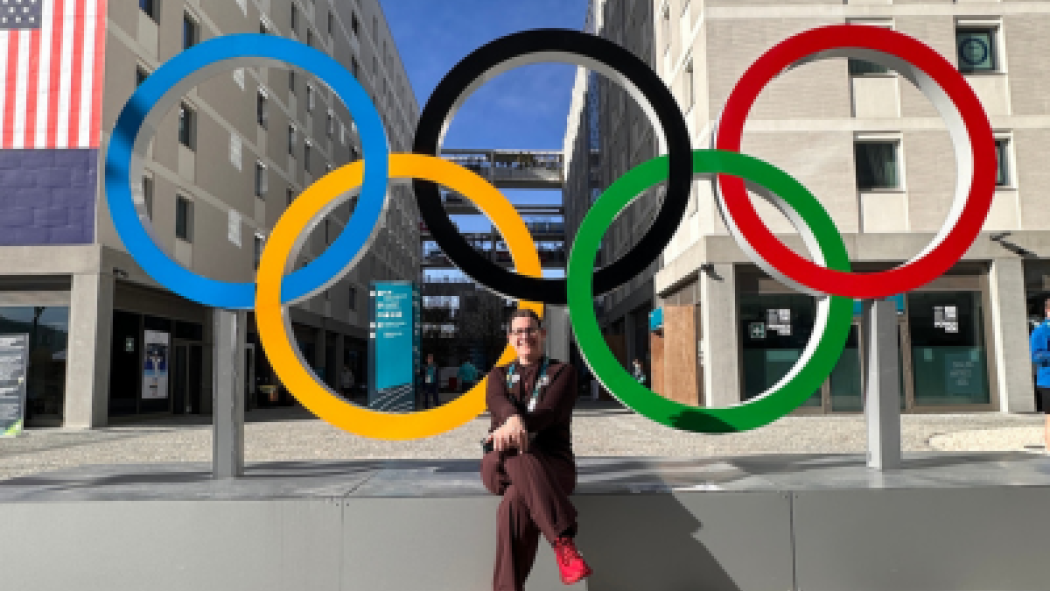
Above: Dr. Tatiana Jevremovic sits in front of the Olympic rings at the Milan Olympic village.
February 23, 2026
When Team Canada steps onto the Olympic stage, a dedicated medical team stands behind them and London Health Sciences Centre’s (LHSC) Dr. Tatiana Jevremovic is proud to be among them. As a physician supporting Canada’s figure skating team, she plays a critical role in keeping competitors healthy, resilient, and ready to perform at their best. In this conversation, Dr. Jevremovic, who is a primary care sport and exercise medicine physician at LHSC and Western University’s Fowler Kennedy Sport Medicine Clinic and Associate professor in the Department of Medicine, shares what it means to represent Canada on the world stage, the rewards of Olympic medicine, and her experience at the 2026 Milano Cortina Games.
What does your role look like as a physician supporting the figure skating team at the Olympics? What are your primary responsibilities day-to-day?
I am the Chief Medical Advisor for Skate Canada. I oversee the medical coverage and services provided to our national level skaters and next generation skaters for both domestic and international events. This includes working with the National Medical Integrated Support Team (IST) to ensure our athletes have the right training program, nutrition and mental health support, assigning physicians to travel to different international events with our skaters, and selecting and/or assisting colleagues in organizing medical coverage for skating events taking place on domestic soil.
While at an event like the Olympics, my day-to-day responsibilities include attending practices and competitions and providing medical care to our athletes as needed.
Figure skating is such a technically demanding sport. What are some of the unique medical considerations that come with caring for elite skaters at this level?
The figure skating season is quite long, which is taxing on the athletes’ bodies and health. We have an injury surveillance program that we monitor weekly to help address any injuries and illnesses in a timely way. We also have regular check-in points with our athletes to make sure that their fitness, nutrition, recovery, and resilience remain optimized.
The Olympic environment is high pressure and fast paced. How do you prepare yourself, both medically and mentally, for this kind of setting?
Medically, the system we have in place (described above) allows us to stay on top of our athletes’ health and to be prepared for such events as the Olympics. Once the Olympic team is selected, we review the selected athletes’ files to make sure that we have all the supplies and equipment we need. We also have a meeting with each athlete to review their medical needs including medications and to make sure that we are ready for the trip. The Canadian Olympic Committee (COC) has a medical team that communicates with us regularly ahead of the Games. They share with us all pertinent information around medical protocols at the Games, as well as the supplies that they will have on hand for us to use.
Mentally, the challenge is being away from family and from work for so long. Fortunately, I have a very supportive husband, daughters, and mother, as well as colleagues in the clinic who have all chipped in to cover my different responsibilities as a physician, wife, and mother.
What surprised you most about being part of the Olympic team environment?
The camaraderie, not just within our figure skating team or Team Canada, but between the different delegations. It really is an event that brings the world together.
Can you share a moment from your time at the Games that has stood out to you?
There were truly a number of amazing moments. One that stands out is the medal ceremony for the men’s dual moguls dubbed the “Dad’s Podium” (with Canada winning gold) where all three medalists celebrated their wins with their partners and children.
How does your work at LHSC prepare you for an opportunity like this? Are there specific skills or experiences that translate directly to the Olympic setting?
Medicine in general requires teamwork and collaboration. I am fortunate to be part of a clinic and a department within LHSC that promotes this culture.
What does it mean to you to represent LHSC, the community, and the country on an international stage like the Olympics?
It’s a career dream come true. Prior to starting a family, I had the pleasure of being part of the host medical team for the Vancouver Olympics in 2010 along with a few of my LHSC colleagues including Dr. Alison Spouge. Being part of Team Canada was left on my bucket list, and I feel very fortunate to be able to complete that goal. I am also very honoured and proud to represent my colleagues at LHSC, Fowler Kennedy, the Department of Family Medicine and the Canadian Academy of Sport and Exercise Medicine (CASEM).