
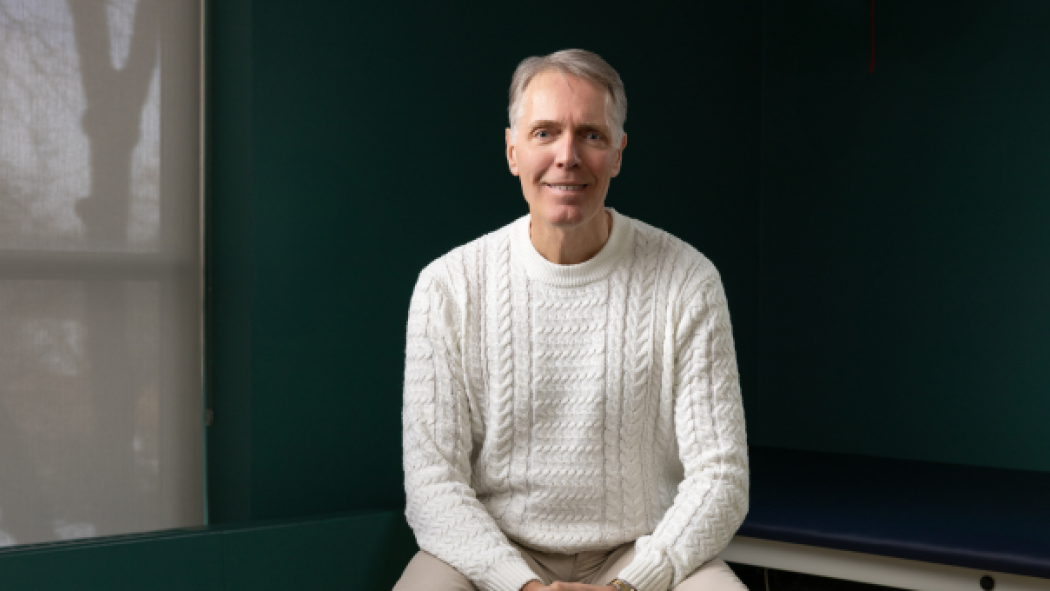
LHSC patient partner in Stroke Care, Mike Tidy
July 20, 2026
One patient partner’s journey to improve care for others
When London Health Sciences Centre (LHSC) patient partner Mike Tidy looks back on his stroke journey, he knows how much came down to timing, access, and quality of care.
“I was lucky,” says Tidy. “Lucky because I live in London where there are a lot of resources available – one being world-class neurologists and a care facility like London Health Sciences Centre, and then another being access to top quality local stroke rehab services.”
Tidy experienced his first stroke in August 2022, and while he considered that to have been traumatic, it was a second more severe stroke that happened months later in March 2023 that had a profound impact.
The second stroke caused significant damage to the base of his brain affecting balance, speech, memory, and executive functioning.
What followed was a week of inpatient care at LHSC that he describes as exceptional. Care that he notes not only felt like he was with expert providers, but also care that was deeply human.
“They were incredible,” says Tidy. “You feel that confidence around you.”
After a week in the stroke unit at LHSC’s University Hospital, he began outpatient rehabilitation at another local hospital organization, where months of outpatient rehabilitation in physiotherapy, occupational therapy and speech-language therapy helped rebuild what had been lost.
“It didn’t happen all at once,” says Tidy. “It was step by step.”
And those steps mattered.
Like many patients recovering from life-altering illness or injury, progress wasn’t always linear. But over time, the small wins began to add up. He was walking more steadily, speaking more clearly, and thinking more fluidly.
Tidy adds, “My wife will remind me that there are things I can do now that I couldn’t do two years ago, which is an important perspective to keep with you as you are moving forward.”
It also changed how he sees life.
Turning recovery into purpose
There is a quiet shift that happens after a major health event. A realization that time, energy and purpose take on new meaning. For Tidy, that meant stepping away from his career much earlier than planned and stepping toward something else: giving back.
“I knew I wasn’t going back to work,” recalls Tidy. “But I also knew I still had something to give.”
Through his post-hospital journey, he was introduced to different ways to get more involved, first volunteering with March of Dimes and later becoming a patient partner at the Southwestern Ontario Stroke Network (SWOSN), at his outpatient rehab care organization, and at LHSC with the Acute Stroke program's District Stroke Council.
His multi-organization involvement is intentional, as he is keen to bring a patient perspective to the broader design and delivery of stroke care across the region. His motivation is simple: no one should have to navigate the stroke care pathway alone.
“There are so many incredible resources out there,” says Tidy. “However, too many people don’t know they exist.”
In a region where hundreds of people experience strokes each year, only a fraction connect with many of the supports available to them after discharge. Stroke rehabilitation programs, peer groups and community services can make a meaningful difference, but only if people know where to find them.
With a professional background in manufacturing, Tidy is also passionate about improving how the broader system works, ensuring care that is not only high quality, but coordinated, efficient and accessible across communities.
“Where you live shouldn’t determine the care you receive,” says Tidy.
Building a better path forward for future stroke survivors
Stroke, he acknowledges, is life-altering. Unlike some illnesses, recovery doesn’t always mean returning to who you were before. There are lasting impacts on independence, identity and daily life. But there is also something else.
“There’s real opportunity to get better. You just have to keep working at it,” offers Tidy.
That work looks different for everyone. For Tidy, it meant rebuilding routines, staying active, making lifestyle changes and leaning into the support of others who understand the journey.
“You learn so much from other survivors,” says Tidy. “There’s a connection there and you don’t feel as alone.”
Today, Tidy continues to lend his voice across multiple organizations in the hopes of helping to shape a more connected, patient-centred stroke system.
Looking back, he describes his recovery as something he had to piece together on his own, a “build-it-yourself” path shaped by persistence and curiosity. It worked, but it also revealed gaps.
“Behind every stroke is a person who is navigating what comes next and through my work as a patient partner, I’d like to make the process easier for the next person,” says Tidy. “In my role as a patient partner with LHSC, I’m keen to explore how the organization can help to better connect some of these dots before patients leave the hospital, while still maintaining the exceptional stroke care the team currently delivers.”
Do you know how to recognize the signs of stroke?
Think “FAST” ...
F – Face: Is it drooping?
A – Arms: Can you raise both?
S – Speech: Is it slurred or jumbled?
T – Time to call 9-1-1
Stroke is a medical emergency. If you, or someone you are with, is experiencing any of these signs, call 9-1-1. Do not drive to the hospital. An ambulance will take you to the closest hospital that provides urgent stroke care.
Stroke resources at-a-glance
Interested in learning more about some of the resources available to patients who have experienced a stroke? Visit LHSC’s Regional Stroke Centre website. Additional information and resources can also be found on the Southwestern Ontario Stroke Network website.