
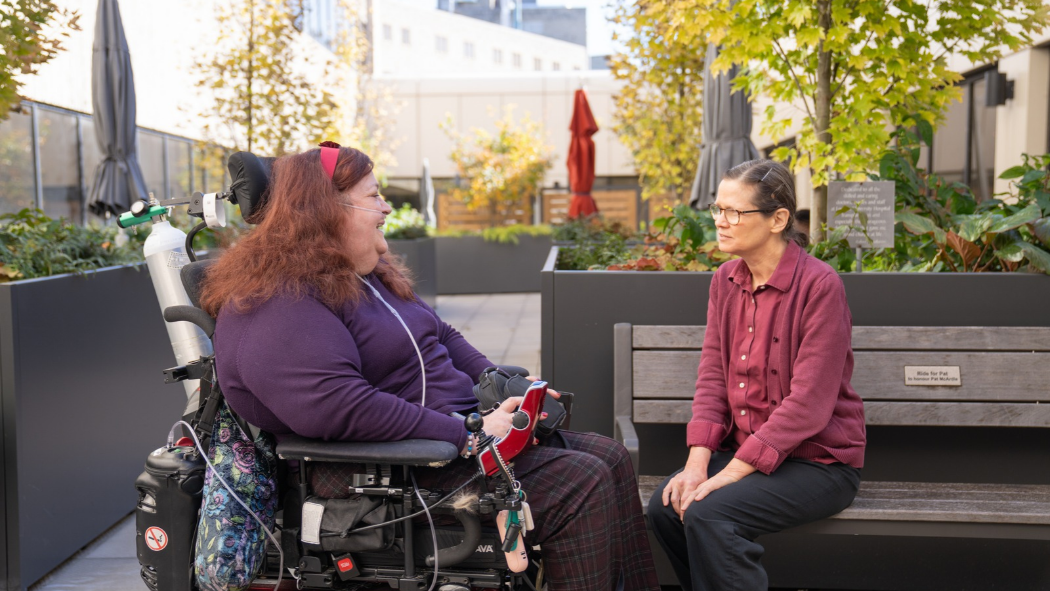
Martha Dyer (L), enjoying an outdoor conversation with Spiritual Care Practitioner, Cathy Regush(R).
October 22, 2026
Hospital stays can often bring uncertainty, fear and grief, but in those moments, sometimes something as simple as having someone there can help with healing and be a source of comfort. Every person that comes through the doors of the hospital brings their own experiences, beliefs and sources of strength, and the Spiritual Care team makes room for all of it.
For Martha Dyer, faith is an important part of her life, and having someone present to support her has made a meaningful difference. Over the past three years, Spiritual Care Practitioner Cathy Regush has become a trusted source of comfort and connection during some of Martha’s most difficult moments at LHSC.
During a previous stay at University Hospital, Martha met with Deb Lines, Recreation Therapist, who recommended meeting Cathy. The first meeting with Cathy led to a years-long relationship of trust and support. “She has become someone that I’ve gotten to know and rely on, and she will always come when I request her and visit with me”, says Martha.
The support became especially meaningful to Martha when she recently experienced two profound losses close together.
While Martha was in hospital, her father was admitted as well. One of her physicians helped arrange for Martha to be in the same room as him during his final days, with Martha commenting that, “being able to be there with him was a gift I can never repay.”
Two weeks after her father died, Martha’s sister also passed away. During that time, Cathy was quietly working in the background to help, asking a simple yet meaningful question.
“Cathy was there with me at my sister’s bedside as she was nearing the end of her life and asked, ‘What can I do for you’. I just said ‘pray’. It gave me a sense of peace.”
For Cathy, being invited into such a personal moment was both a privilege and a responsibility. “When I am invited into these moments, I think of them as sacred ground,” says Cathy. “It is an incredible blessing to be present with someone and to support them in the way they need.”
In the weeks that followed, Cathy continued to offer Martha a place to talk openly about her grief, fears and challenges. She reminded Martha that grief was not something she simply had to “get over,” but something she could move through in her own way and at her own pace.
“She helped me recognize the support I already had around me,” says Martha. “When I felt overwhelmed by everything that needed to be done, she reminded me that things would present themselves as they came and that I would be able to work through them.”
Personalized Care – spiritual vs non-spiritual
Although faith is important to Martha, Spiritual Care is not limited to those who identify with a particular religion. It is available to people of all spiritual, cultural and religious backgrounds, as well as those who are atheist, agnostic or non-religious. “One of the biggest misconceptions is that Spiritual Care is only about religion or Christianity, but it’s for everyone,” says Martha. “It may be helpful to someone who doesn’t even realize this kind of support is available to them.”
Rather than arriving with a set idea of what a visit should look like, Cathy takes her lead from the person she is supporting. The conversation might explore faith, values or sources of strength, or it may simply provide space to share a story, enjoy a laugh, or feel heard. “I want to learn what they need and how I can best support them,” says Cathy. “Every person and every visit is different. I want people to know they are accepted for who they are. Whether a person is religious, spiritual or neither, the message is the same: You are a human being, and you matter.”
Support throughout the hospital journey
Another common misconception is that Spiritual Care is only available at the end of life. In reality, support is available at any point throughout a person’s hospital journey to help with navigating a lengthy admission or difficult news to experiencing grief, uncertainty or simply needing someone to listen. Spiritual support is also available to families, visitors and staff, and can sometimes help connect people with other services that may better meet their needs.
Cathy emphasizes that there is no expectation for visits to look a certain way as your care team will always find the support that works best for you. “Some visits are light and filled with laughter, while others are deep and profound,” she says. “I am grateful to be able to meet people where they are and offer what they need in that moment. It touches my heart to be able to do this work.”