
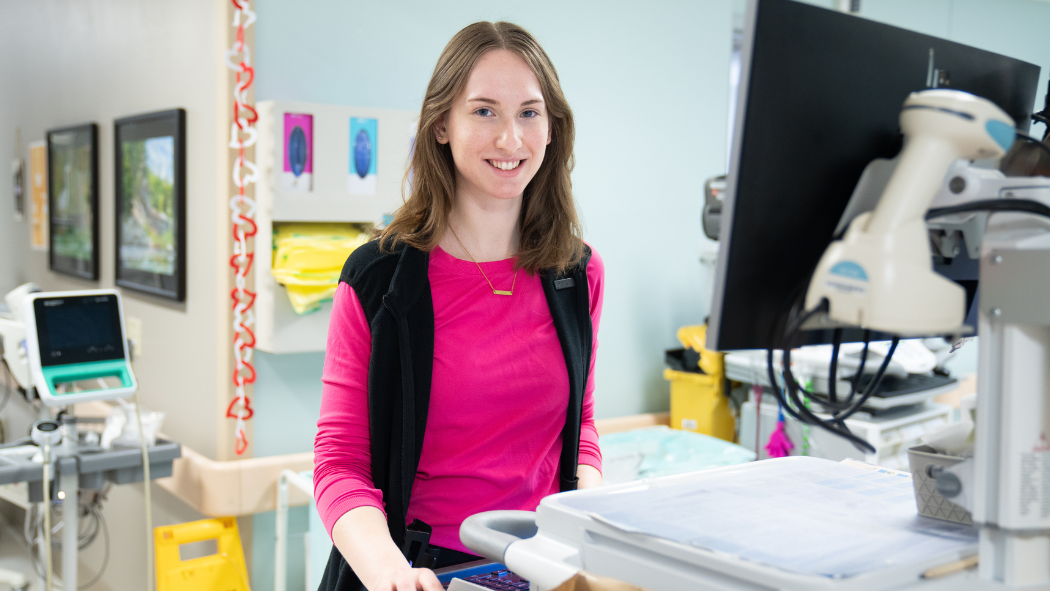
Image: Emma Van Dyk is a member of LHSC's Nursing Resource Team.
May 25, 2026
For as long as she can remember, Emma Van Dyk has navigated the world differently than most people. She was born with a genetic condition affecting the clarity of her central vision that even glasses cannot fully correct. As a result, she is considered legally blind.
Rather than allowing that reality to limit her ambitions, Van Dyk has built a career around caring for others. Today, she brings that lived experience into her work as a nurse at London Health Sciences Centre (LHSC).
After graduating from Western University in 2024, Van Dyk joined the Nursing Resource Team at Victoria Hospital, where she now works across different units to support staffing needs. Throughout school and her professional practice, accessibility tools such as screen magnification software and large-print materials have helped her navigate coursework, documentation, and patient care.
In her day-to-day work, Van Dyk has developed practical strategies that allow her to work safely and effectively.
“I bring medication vials closer to my face so I can read them, and I’ll raise the patient’s bed higher when I’m doing my assessments.”
While accommodations help her perform her job, they can also draw unwanted attention. Van Dyk says people often notice her enlarged computer screen or the way she leans in closely while charting, leading to questions or comments.
“I often get questions about my magnified screen,” she says. “People sometimes ask if I need glasses.”
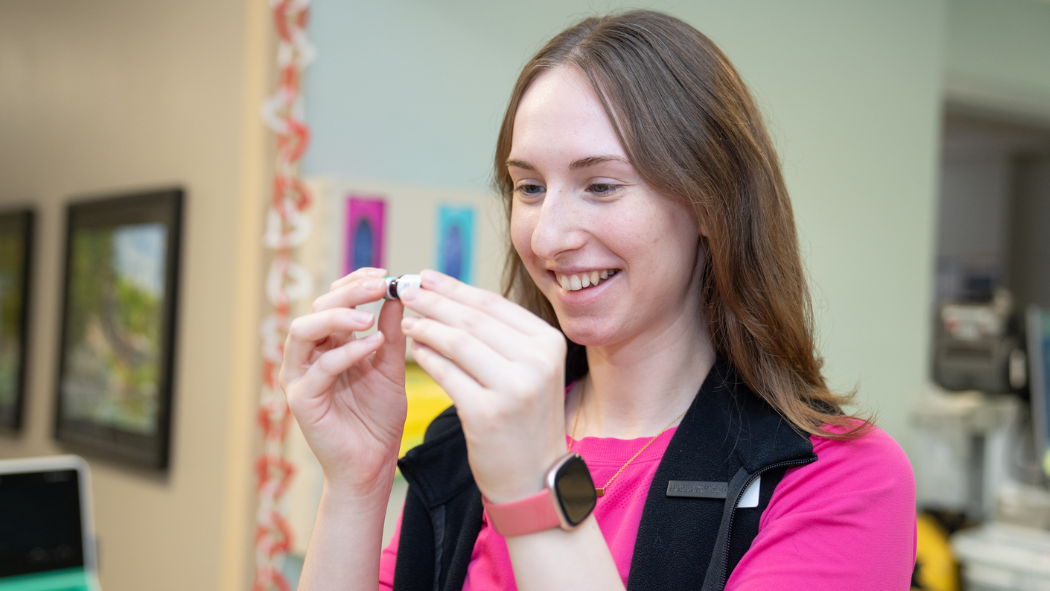
Image: Van Dyk holds a medicine vial close to her face to read the label.
An inclusive workplace that supports the unique needs of the whole team is key to a thriving work environment for all. For Van Dyk, conversations help foster understanding, while casual remarks or assumptions can lead to her feeling isolated.
She recommends that people make the effort to ask questions and show a genuine interest in learning.
At the same time, Van Dyk believes her experiences have strengthened her ability to provide compassionate care. Living with a low vision has taught her not to make assumptions about other people and to remain flexible in how she approaches each patient and situation.
Van Dyk’s story is an important reminder of how accessibility and accommodations can enable people to fully contribute their skills in the workplace.
“At LHSC, we are advancing accessibility with intention and addressing barriers through action to ensure that every member of Team LHSC has the opportunity to contribute, belong, and thrive,” says Julia Marchesan, Vice President, People and Employee Experience, IPAC, and Health Disciplines. “As we move forward in this work, we are strengthening a culture where every individual can bring their perspective, lived experience, and talent to the work of delivering and supporting compassionate, exceptional care.”