
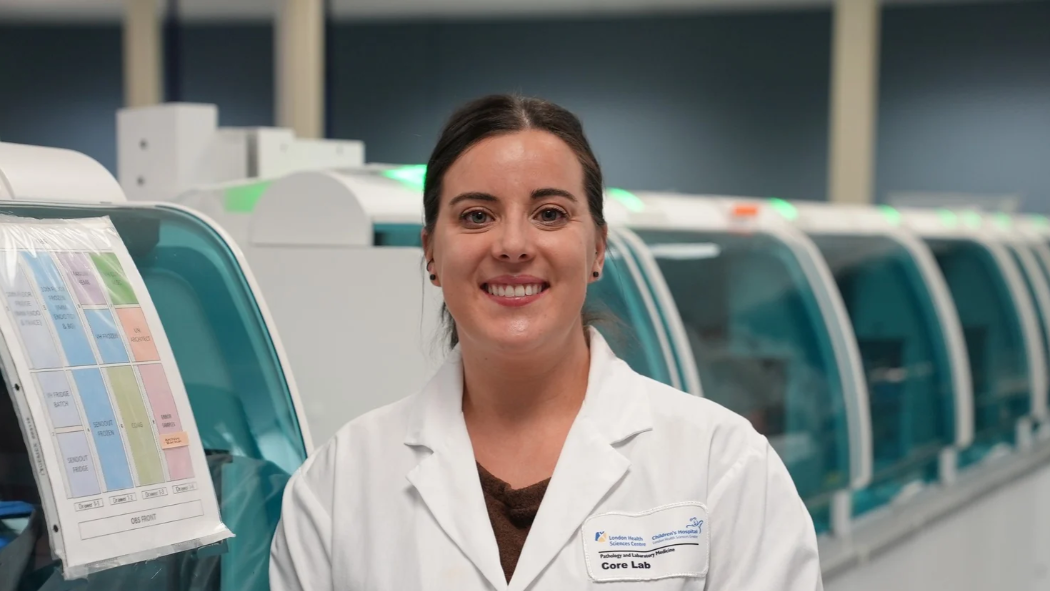
Kristen Mendonca, medical laboratory technologist stands in front of automated lab equipment at Victoria and Children's Hospital Core Labs.
November 12, 2026
London Health Sciences Centre's (LHSC) Core Labs have powered up their capacity thanks to a significant upgrade to testing equipment that will mean faster access to results for patients.
The labs at University Hospital and Victoria Hospital, which are the main intake for patient bloodwork, now have the ability to process more than a combined 15,000 tests an hour thanks to the upgrades. That’s an increase of a little more than 24 per cent from previous levels. Additional equipment used to prepare samples for testing was also refreshed, extending its useful life by five years.
The work to install the new equipment took place over the spring and summer months and was funded through LHSC's existing budget. By the end of August, the new technology was firing on all cylinders, helping to diagnose and monitor more patients faster.
Patient impact in every test
The upgrades to the Core Labs help the dedicated staff members within the Pathology and Laboratory Medicine (PaLM) department ensure care teams and patients have access to the health information they need as quickly as possible.
“Although we work behind the scenes, the results we generate play a critical role in diagnosis and treatment decisions,” says Kristen Mendonca, a medical laboratory technologist who works within the Core Labs. She helped test the new equipment after it was installed and supported her coworkers' training.
The tests that Mendonca and her colleagues process and analyze are used by physicians to diagnose patients with conditions including diabetes and infections as well as heart, kidney and liver disease; all ailments that require timely interventions and treatments.
Samples that are first tested in the Core Labs are also sent to other specialized laboratories at LHSC for further analysis when necessary.
“I enjoy knowing that my work directly supports patient care and contributes to positive patient outcomes,” Mendonca says.
Faster results, improved reliability
Even though the new and refreshed equipment has only been up and running fully for a few months, the difference is noticeable.
“Compared with previous models, the new equipment offers improved automation, faster processing, increased testing capacity and greater reliability,” explains Jade Bolsover, manager of Core Laboratories, Flow Cytometry, Transfusion Medicine and Transplant Immunology within the broader PaLM team. The new machines also require less hands-on maintenance from staff.
Since coming online at Victoria Hospital, which also provides testing for Children's Hospital, the team has noted that the new equipment is active and available for use more often.
“While turnaround time data is still being monitored, early results show a positive trend,” Bolsover says.
PaLM is a joint venture between LHSC and St. Joseph’s Health Care London (St. Joseph's). St. Joseph's has also upgraded part of its Core Lab facility.
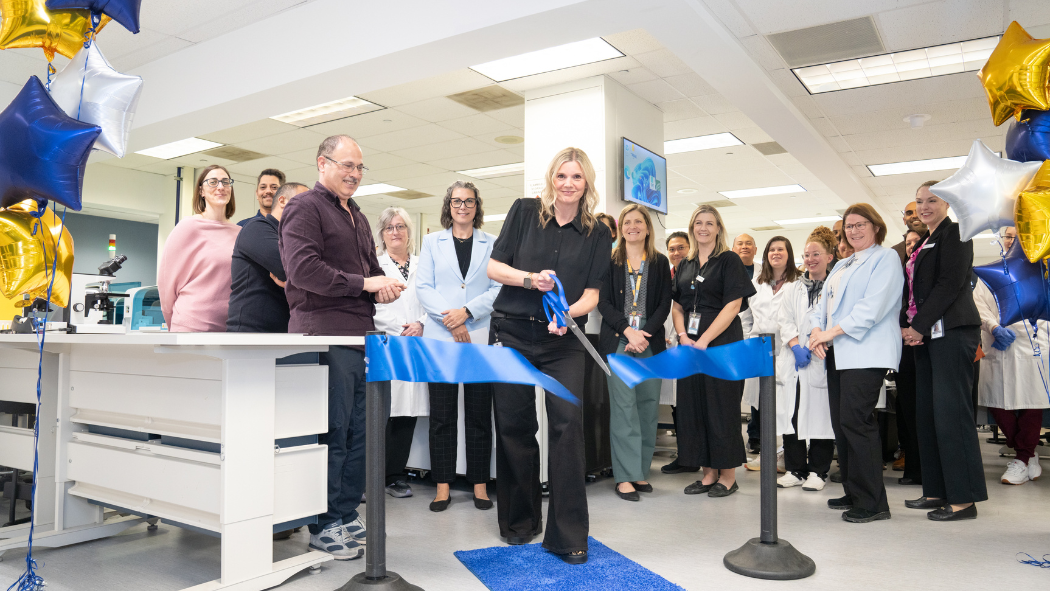
Photo: Members of PaLM celebrate upgrade with a ribbon cutting at Victoria and Children's Hospital Core Labs.
Fast Facts:
- LHSC has 21 laboratories across all its sites that diagnose everything from common ailments to rare diseases
- The Core Labs are the main intake for bloodwork from patients in LHSC’s three Emergency Departments as well as in-patient units and clinics across University Hospital, Victoria Hospital and Children’s Hospital
- The Core Labs run 24 hours a day, 365 days a year
- Specialized LHSC laboratories include Biochemistry, Microbiology, Molecular Diagnostics, Pathology, Transfusion Medicine and Transplant Immunology
- More than eight million tests are performed per year for patients across Southwestern Ontario within PaLM’s labs
- Approximately 60 medical laboratory technologists and 50 medical laboratory assistants work diligently to process and analyze test samples 24 hours a day, seven days a week