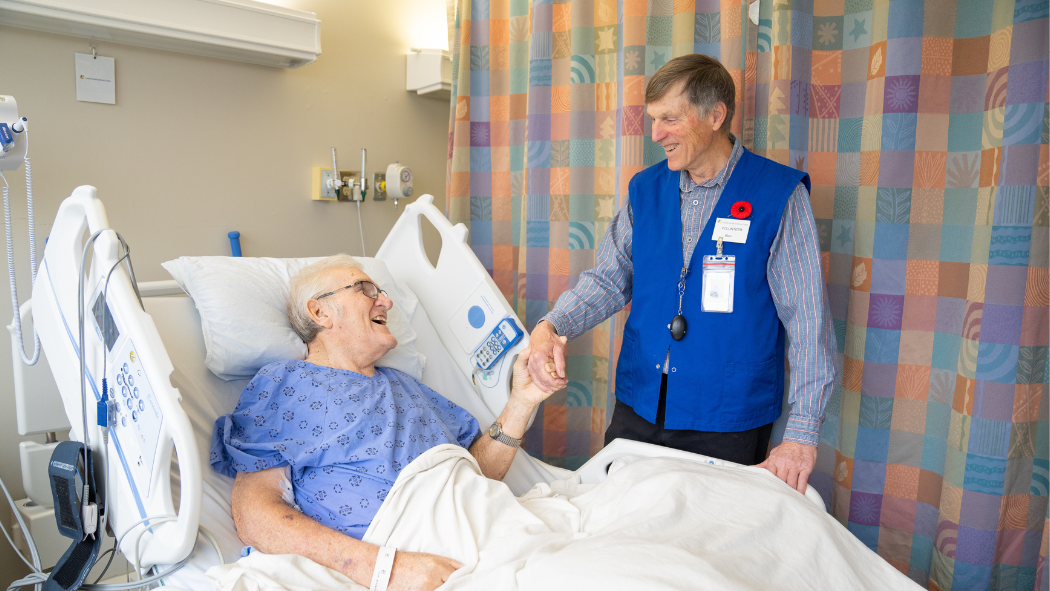
Above: Alan Salmoni (right) has a conversation with Andy Donker (left), a patient on the Orthopaedic Inpatient Unit at University Hospital.
January 26, 2026
Retirement can be a challenging adjustment for many people, particularly when it comes to finding purpose. That was a concern on the mind of Alan Salmoni when he retired from his longtime job as a professor in the School of Kinesiology at Western University in 2019.
“I thought it would be difficult to replace the work that I loved,” he recounts.
It wasn’t long, however, before Alan found something fulfilling to pour his energy into. Shortly after retiring, he took a page out of his brother’s book and registered as a volunteer at London Health Sciences Centre (LHSC).
“My brother had volunteered at a hospital in Sarnia since he retired,” he says. “And I thought, if my brother can do that, surely I can too.”
As someone who enjoys talking and socializing, visiting with inpatients in the Sub-Acute Medicine Unit (SAMU) at University Hospital seemed like a volunteer role tailor-made for Alan. During his time as a university professor, he had even conducted research on related topics such as long-term care and factors impacting patient falls.
“After a few shifts I realized that I loved doing it,” he says. “You get to hear such wonderful stories about people.”
Across LHSC, there are more than 30 patient visiting volunteers, supporting six different programs and clinics with conversations and social interactions that help enrich the patient experience. Alan has spent several years volunteering in the SAMU and Palliative Care, where he found a passion for unearthing what he calls each person’s ‘human story.’ “Every patient I’ve talked to over the past six years has been interesting,” he says. “I tell other people now, every human has a story, and I have the luxury of listening to them.”
Orthopaedic Inpatient Surgery
Earlier this year, when the Orthopaedic Surgery Inpatient Unit at University Hospital reintroduced its volunteer visiting program, Alan was asked if he’d be interested in expanding his roles and became their first volunteer.
Every Tuesday afternoon, he visits patients on this unit, particularly those who are in the hospital for an extended period during their recovery from surgery. This includes patients like Andy Donker, who was in the hospital for seven weeks following hip surgery.
“Alan was one of the first people I met,” says Donker. “He’s a very passionate man. You couldn’t ask for a better volunteer for this type of role.”
Andy had a lot of support from family and friends during his hospital stay, but he says that visits from volunteers like Alan helped pass the time and gave him a spark of hope. For someone with fewer visitors from home, he thinks the volunteer visiting program would make a world of difference.
Patient Visiting Program
The patient visiting program is one of the many services provided by volunteers at LHSC. In many units, like the Chemotherapy Suite at the Verspeeten Family Cancer Centre and the Dialysis Unit, volunteers often see the same patients each week, allowing them to form meaningful relationships that help patients feel comfortable and supported. The visiting program continues to grow, and units interested in participating can request a volunteer role through Volunteer Services.
“Whether they are supporting individuals on our Sub-Acute Medicine and Palliative Care units, engaging patients in the Epilepsy Monitoring Unit, or providing companionship on our Alternate Level of Care units, our patient visiting volunteers help create a sense of community and ease moments of isolation,” says Meaghan Innes, Manager of Volunteer Services at LHSC. “Their presence brings comfort to patients and families and strengthens the compassionate environment we strive to provide every day.”
For Alan, the value of his role was never more apparent than when his wife spent some time in the hospital earlier this year.
“Frontline workers don’t have time to sit and chat with someone for 40 minutes; they’re busy doing their jobs and helping people feel better,” he says. “I see that as my role – a volunteer has the time for emotional care and that’s really what we’re doing.”