

Above: Members of the LHSC Green Team ITS Subcommittee celebrate with successful print reduction partners. From left to right: Stewart Coppins, Kristin Ladd, Mike Apostol, Nerissa Taylor, Andrew Mes and Patricia Fueta who holds the digital certificate recognizing Emergency Departments at Victoria Hospital and Children’s Hospital for their print reduction contributions.
April 28, 2026
As one of the largest hospitals in Canada and one of the largest employers in London, Ontario, when London Health Sciences Centre (LHSC) makes a seemingly small change toward environmental sustainability, it makes a big impact. That's the attitude Team LHSC embraced to reach a crucial environmental milestone in November 2025.
With the leadership and passion of LHSC’s Green Team Information Technology Services (ITS) Subcommittee, LHSC set out to reduce its printing by 10 per cent and reached this goal ahead of the original target of March 31, 2026.
As of March 2026, LHSC has reduced its annual printing volume by 13.4 per cent, representing a reduction in use of 3.9 million pieces of paper or the equivalent of 390 trees. It also represents savings of up to $100,000 per year.
Achieving this goal brings immense benefits for LHSC’s environmental sustainability and financial responsibility, and these incredible savings aren’t possible without dedicated collaboration.
Collaborating to reduce waste
At LHSC, hundreds of automatic reports for patient care, unit logistics, and more are printed each day. Taking the time to determine what can be eliminated is only possible with dedicated behind-the-scenes work.
Empowered by LHSC’s establishment of the printing reduction goal, Arthur Chan, from LHSC Pharmacy, and Tia Wiebe, Health Information Management Support Specialist, were the behind-the-scenes drivers of their departments’ paper reduction. They were able to prioritize streamlining report processes, having faxes sent to email, and ensuring that Pharmacy and Health Information Management could identify their necessary hard-copy needs.
Pharmacies across LHSC achieved a 25 per cent reduction, nearly 300,000 sheets per year, by revisiting old practices.
“There were automatic reports printed in the Pharmacy department simply because we had always done so, but they often went right into the recycling bin. To focus on reducing paper waste, we needed the tools to create solutions,” shares Arthur Chan, Evidence Based Medicine Pharmacist.

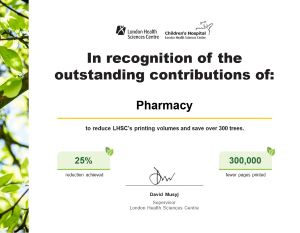
Above: Arthur Chan alongside the digital certificate recognizing Pharmacy’s contribution to print reduction.
Within Health Information Management, Tia Wiebe, Support Specialist, credits leadership support for helping make all the difference in achieving their department’s 59 per cent reduction, over 400,000 sheets per year!
“My leader encouraged me to meet with clinical spaces to determine how specific reports impacted their work,” explains Wiebe. “When we found reports that no longer met a need or had extraneous information, I could make significant reductions.”

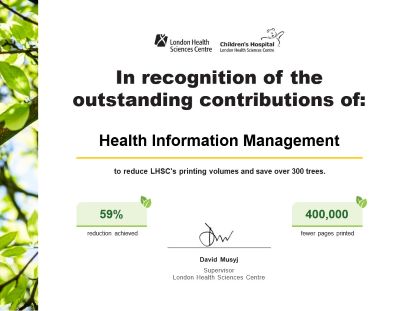
Above: Tia Wiebe alongside the digital certificate recognizing Health Information Management’s contribution to print reduction.
How print reductions enhance great care
Initially, LHSC Emergency Departments (EDs) were one of the highest-volume printing areas. When patient flow and timing of care are of the utmost priority, changes must enhance these aspects of care. Going chartless helped streamline care, as digital charts allow for quick access and consistency.
Emergency Physician, Frank Myslik explains, “Our primary concern is always going to be the health of our patients. We had to know that making the switch to digital would help us serve our patients best. Electronic charting ensures real-time access to crucial patient information across a health-care team. Having the right digital tools for the ED improves our workflow and provides the most efficient patient care. It’s an added benefit that being patient-centric and digital helps our broader environment.”
Thanks to a concerted effort by all staff, the Victoria Hospital and Children’s Hospital EDs reduced printing by 54 per cent, nearly half a million sheets per year, while the University Hospital ED reduced printing by 24 per cent, around 125,000 sheets per year.

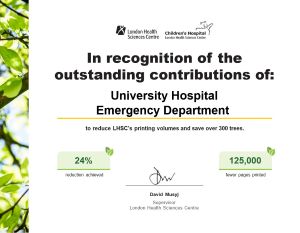
Above: Frank Myslik alongside the digital certificate recognizing University Hospital Emergency Department’s contribution to print reduction.
By exceeding the initial 10 per cent reduction goal, Team LHSC is helping:
• Spare 390 trees
• Reduce 159,000 kg of CO2 emission – the equivalent to taking 49 cars permanently off the road
• Save 1.58 million litres of water – equivalent to 12,700 baths
• Eliminate 10,467 kg of waste
• Save upwards of $100,000 in print-related costs
“A vital part of providing great care is understanding how the environment impacts health. In 2024, LHSC took the initiative to implement our first-ever organizational sustainability target,” says David Musyj, LHSC Supervisor. “By reaching this goal, LHSC is becoming more environmentally friendly while continuing to provide great care to our patients.”
This milestone is an encouraging reminder that small, daily changes make a lasting, positive impact on the environment, the hospital, and the broader community.
Team LHSC’s 10 per cent achievement is just the beginning. Since first reaching this milestone in November 2025, LHSC’s paper waste continues to decrease across departments as more teams collaborate to be digital-first.