
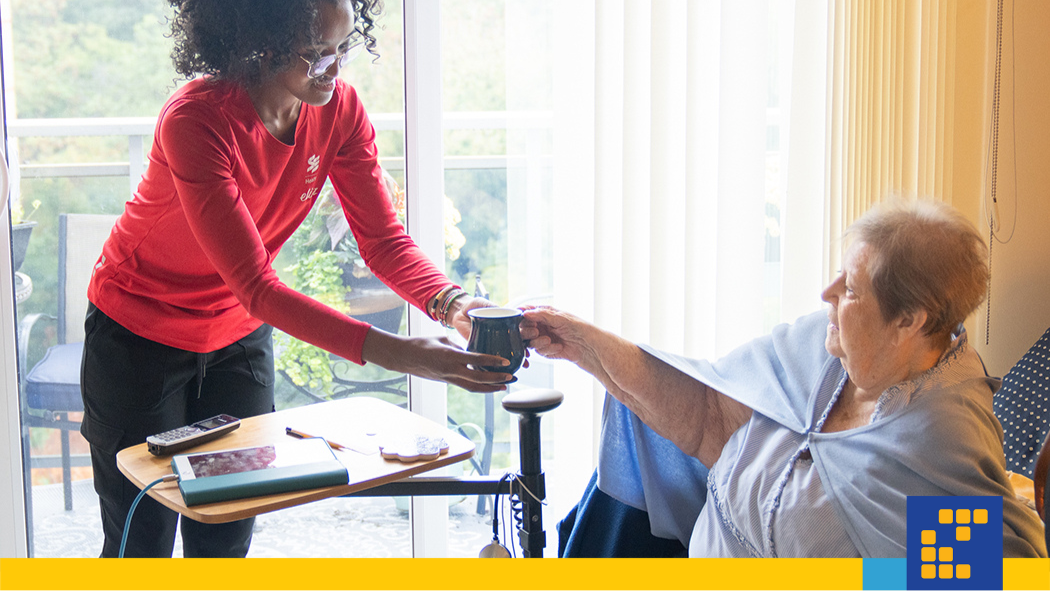
Annet Mokua (left) was Elisabeth Hutchison’s (right) personal support worker as part of her LHSC to Home care team.
December 4, 2025
When Elisabeth Hutchison was first admitted to London Health Sciences Centre (LHSC), she was fighting for her life.
In addition to suffering from bacteremia caused by an infected wound, she was extremely anemic due to an iron deficiency, had a blood clot in her lungs, and was bleeding internally from an undiagnosed ulcer. To top it off, Elisabeth was also struggling with COVID-19 symptoms.
“Three different doctors told me they were surprised to see me alive,” she recalled. “It was one health issue after another, and I just kept dealing with them one at a time.”
After weeks of treatment in the hospital, Elisabeth faced a new challenge: returning home safely to recover. For many patients, the transition from hospital to home can be daunting, especially after complex health challenges.
To support patients through this transition, LHSC created LHSC to Home, a program designed to ensure patients continue to receive care even after they leave the hospital.
A seamless transition home
Elisabeth’s experience reflected a gap in how care is typically delivered. Patients may be ready to leave the hospital and the specialized care provided there, but not yet fully equipped to manage their recovery alone. That is where LHSC to Home comes in.
Supported by Ontario Ministry of Health and delivered in partnership with SE Health, LHSC to Home is part of LHSC’s broader Home First strategy, which prioritizes supporting patients to recover at home whenever possible. The goal of the program is to ensure patients receive the right care in the right place, helping them recover and reduce the risks associated with lengthy hospital stays. This enables families to be supported in a familiar and comfortable environment.
LHSC to Home draws on the success of other hospital-to-home models from across the province and represents a significant step forward in delivering patient-centered care and fostering collaboration across the health-care continuum.
Over the past year, LHSC to Home has supported more than 500 patients who are ready to leave the hospital but still require ongoing care at home or in the community. The program provides eight to sixteen weeks of wraparound home and community care services through SE Health's team of nurses, personal support workers, therapists, and other specialists. Patients receive care plans tailored to their specific needs that enable recovery in an environment where they feel safe and comfortable.
“LHSC to Home is about getting patients back home so they can heal and recover in the environment where they will be most successful,” explains Tania Marques, LHSC to Home Facilitator.
“Studies have shown that patients often lose fitness and muscle tone due to a lack of exercise and activity during long hospital stays. With this program, we help them return to their day-to-day activities faster and more safely by sending them home with a personalized care plan and the right supports in place.”
Flexible, personalized care
Elisabeth admits she wasn’t sure what to expect when she was first introduced to LHSC to Home.
“I had a great relationship with my LHSC to Home care team and my care plan changed to meet my needs throughout my recovery. That consistency and flexibility made all the difference in helping me do things independently again.”
As her strength improved, Elisabeth’s care team was able to adjust the level of support they provided.
“My care team was reliable, knowledgeable, and consistent,” Elisabeth said. “It was high quality care, and I benefited immensely from it.”
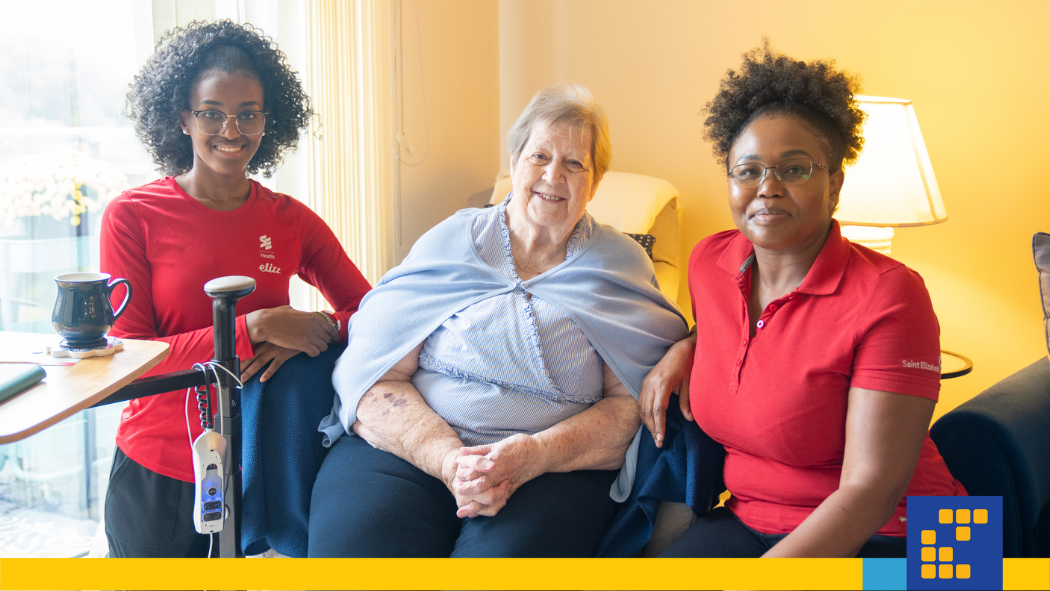
Image (left to right): Annet Mokua, personal support worker with SE Health, Elisabeth Hutchison, LHSC to Home patient, and Phanice Mokua, registered nurse specializing in wound, ostomy and continence care with SE Health.
Continuity and connection
During her time with the LHSC to Home program, Elisabeth was supported by a care team that included sisters Phanice and Annet Mokua. Phanice is a registered nurse specializing in wound, ostomy, and continence care, while Annet is a personal support worker. Together, they provided medical and daily living support on a consistent basis, which enabled them to foster a unique bond with Elisabeth.
One morning, that consistency proved lifesaving. During one of her daily visits, Annet found Elisabeth unusually weak and unresponsive.
“Regular care is an important part of any patient’s recovery,” says Annet. “Because I saw Elisabeth so often, I could immediately see when something wasn’t right.”
Recognizing that Elisabeth’s symptoms were potentially life threatening, she calmly followed the program’s escalation process by calling the nursing team, notifying Elisabeth’s family, and coordinating a 911 response. Elisabeth was quickly readmitted to LHSC for urgent care.
The moment demonstrated the strength of the partnership between LHSC and SE Health.
A trusted partnership
As experts in community-based care, the partnership with SE Health has enabled LHSC to extend its reach beyond hospital walls and ensure patients receive seamless, high-quality support.
“SE Health brings a wealth of experience in home and community care, and our LHSC teams are able to contribute acute-care knowledge. Together, we’re creating a continuous circle of care for patients,” says Marques. “We are grateful for their partnership and value the close working relationship we share.”
For SE Health, the partnership is equally important.
“We are thrilled to collaborate with London Health Sciences Centre on this innovative and integrated model that is redefining how we deliver authentic, people-centred care,” said Nancy Lefebre, Chief Operating Officer and Senior Vice-President at SE Health. “Together, we’re helping patients and families experience a safer, smoother transition from hospital to home, strengthening connection, compassion and continuity along the way.”
Advancing integrated care
“LHSC to Home advances LHSC’s Strategic Priorities by enhancing integrated, people-centred care; improving quality, safety, and system leadership; and strengthening the transition from hospital to home,” say Tammy Quigley, Vice President of Cancer, Renal, Mental Health and Patient Flow. “The program bridges acute and community care to create a connected, personalized recovery journey. Each care plan is tailored to individual goals, and collaboration with SE Health provides a sustainable solution that eases pressure on hospitals while improving patient experiences and outcomes.”
The program also advances health equity by minimizing barriers to accessing holistic care and delivering services that are culturally appropriate, culturally safe, and trauma-informed.
Home, where healing happens
Today, Elisabeth is thriving. She is stronger, more independent, and grateful for the team who helped make her recovery possible.
“Being part of the LHSC to Home program was an exceptional experience,” she said. “It always felt like the focus was on the patient and not the process. It gave me back my independence and my life.”