
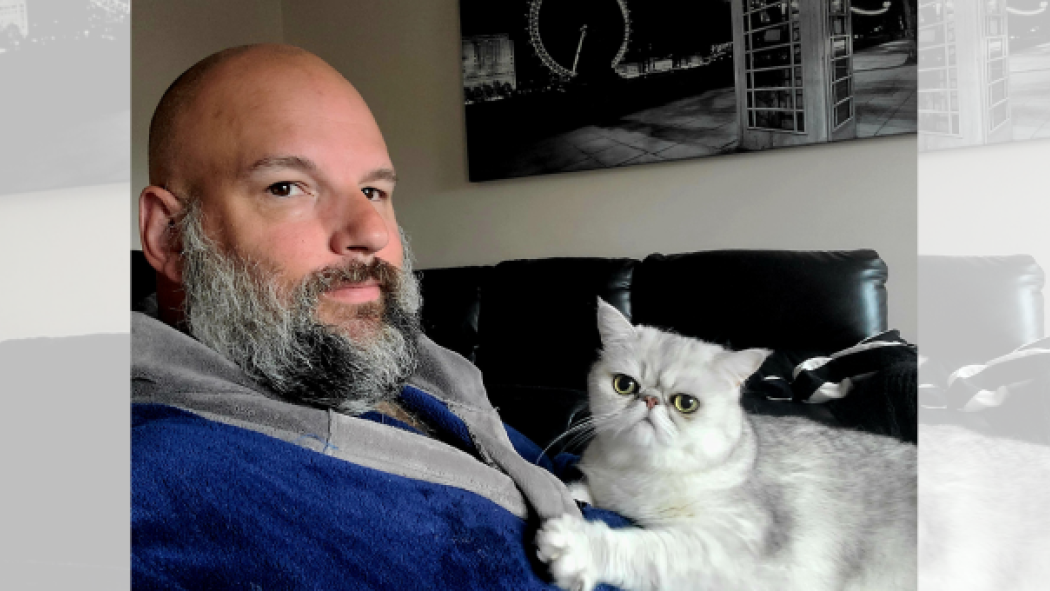
This epilepsy awareness month, LHSC patient Kevin Beaulieu (pictured with his “emotional support cat” Maximus) shares his renewed focus on life, health and the importance of connection
March 25, 2026
For London Health Sciences Centre (LHSC) patient Kevin Beaulieu, life changed in an instant and then changed again in ways he never could have imagined.
An active father, athlete and outdoors enthusiast, Beaulieu had never given much thought to neurological health until 2022, when he experienced his first seizure. At the time, it was suspected to be linked to alcohol withdrawal. Just days earlier, he had returned from a weekend away that involved heavier drinking than usual. In the middle of the night, his wife heard him choking. When she found him, he was seizing and turning blue.
“She saved my life,” says Beaulieu. “I was so close to dying that I said I would never drink again, and I didn’t.”
Motivated by that scare, he immediately stopped drinking and focused on improving his physical health. He returned to working out, spent time with his family and believed the episode was behind him.
But months later, another seizure changed everything.
When answers began to emerge
After experiencing a second seizure a couple months later, Beaulieu was sent to an area hospital for EEG testing that found epileptic activity. While he didn’t have a diagnosis at that point, it seemed a lack of sleep and fatigue was a common factor each time he experienced seizure activity, and that became very mentally taxing.
“That was absolutely life-changing,” he says. “I went from being an active person to completely shutting down.”
Beaulieu was referred to LHSC’s epilepsy program and diagnosed with nocturnal temporal lobe epilepsy. These are seizures that occur during sleep and appear without warning. While doctors can’t say for certain what caused it, the diagnosis brought clarity after months of uncertainty.
Looking back, he recalls his mother once telling him that as a baby, he had a seizure. His father was in the car with him and turned back to see him seizing. His lips turned blue but returned to normal within seconds. Doctors at the time said it could have been due to high fever, but he should be aware that he could be susceptible to further seizures. Beaulieu admits he wonders whether epilepsy was something he always had that was dormant for many years.
The hidden weight of epilepsy
While medication helped control the seizures, the side effects were overwhelming. Severe headaches and migraines left him unable to tolerate light, forcing him indoors and cutting him off from everyday life.
“I was in so much pain that I honestly considered MAID,” shares Beaulieu. “I was ready to give up.”
With the support of his neurologist at LHSC’s University Hospital, his treatment plan was adjusted. A second medication relieved the debilitating pain and with it came a new turning point.
“I could go back outside. I could be in the sun again,” he says. “It gave me a new appreciation for life.”
Finding strength through support
Even with physical symptoms improving, the emotional toll of epilepsy lingered. When speaking about the early days of his diagnosis, he describes a deep sense of loneliness.
“When you grow up, your friends are just there. But as life goes on, people scatter. When I was diagnosed, I kept wondering, where is everyone?”.
That realization led to resentment, isolation and a sharp decline in his mental health. But with his wife by his side and support from Epilepsy Southwestern Ontario (ESWO), he began to see that help sometimes comes from unexpected places.
“I had to learn that the support systems I needed weren’t always the ones I expected,” he says. “I had to get up and take care of myself. I needed to join support groups and find people who truly understood what I was going through.”
Connecting with others who are living with epilepsy helped him rebuild a sense of community and belonging.
“I don’t feel so alone anymore,” he says. “I have the people that matter around me, and that’s enough.”
Ongoing care and looking ahead
Today, Beaulieu continues to receive follow-up care at LHSC, seeing his neurologist every six months. His condition is well controlled with medication, having no seizure activity since August 2024, which allows him to live an active and meaningful life.
When he thinks of the future, he hopes to challenge common misconceptions.
“People hear epilepsy and immediately assume you can’t drive or live independently,” he says. “That’s not always true. We need to eliminate the stereotypes.”
But above all, he emphasizes the importance of mental wellbeing.
“An epilepsy diagnosis isn’t the end of the road,” says Beaulieu. “There is still so much life to live. Find your community and as you work with your medical team to manage the seizures, don’t overlook the importance of fostering your mental wellness.”
Today, he continues to move forward with gratitude, resilience and a renewed sense of purpose. He is living proof that even after life’s most unexpected turns, happiness, health and connection remain possible.
Founded in 1987, LHSC’s internationally recognized Epilepsy Monitoring Unit (EMU) is the largest in Canada and provides care for national and international patients. Located at University Hospital, the EMU is a leader in its field and is active in training neurologists and neurosurgeons from around the world. The three main reasons for EMU admissions are diagnosis, classification of seizure type, and pre-surgical evaluation.