
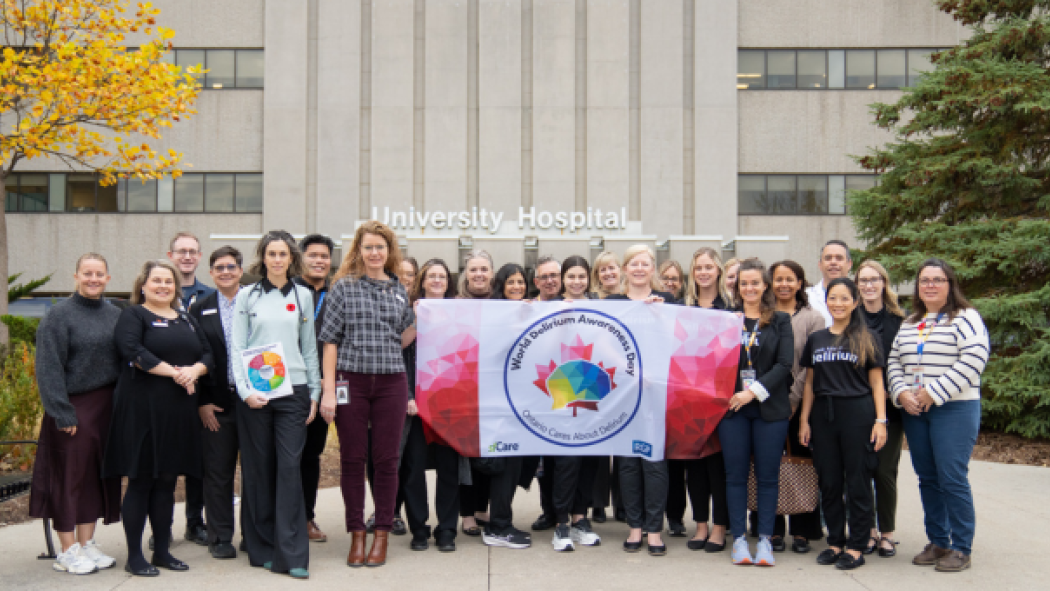
Members of Team LHSC who help support delirium care gather with the Ontario Delirium Flag outside of University Hospital.
January 23, 2026
As the largest hospital in southwestern Ontario, London Health Sciences Centre (LHSC) is proud to be among the health-care organizations participating in Ontario’s Delirium Awareness Flag Campaign.
Hospital-acquired delirium is one of the leading causes of preventable hospital harms in Ontario, and in addition to raising awareness for this serious condition, LHSC is taking multiple actions across our organization to do our part to improve this provincial statistic and better serve at-risk patients and families.
What is delirium?
Delirium is sudden change that causes confusion and uncharacteristic behavior. People may struggle to pay attention to what’s going on around them, and their thinking may not be clear. This can be scary for the person with delirium. It can be frightening and challenging for the people caring for them as well.
Delirium also impacts patient and provider safety, access and flow, and alternate level of care days. It is associated with increased mortality and prolongs an affected patient’s length of stay in hospital by an average of an eight days.
What actions is LHSC taking?
At LHSC, delirium care begins with delirium prevention. Our inpatient teams across Medicine, Surgery and Clinical Neurological Sciences follow early and routine screening processes for all patients identified as at-risk for experiencing delirium. Working in partnership with patients, families, and care partners, we are continually improving how we prevent delirium. When prevention isn’t possible, we focus on early interventions to support recovery and reduce the impact on thinking, independence, and function.
Additionally, our internal multidisciplinary delirium prevention project team at LHSC is also working to implement four key initiatives that include co-designed patient and family education materials, refreshed delirium-friendly order sets, a post-operative delirium pathway, and research with our peer hospitals.
How do you screen for delirium?
On our inpatient units across Medicine, Surgery and Clinical Neurological Sciences, we use a test called the 4-AT to diagnose our patients with delirium. During this test, we ask patients about the “4 A's”:
- Alertness: Ask them what their name or address is
- Attention: Ask them to recite the months of the year or days of the week backwards
- Abbreviated mental test: Ask them their age, date of birth, place (name of hospital), and current year
- Acute change: Ask you whether there’s been a change in their thinking or behaviour
Care partners, family members and other support persons play an important role in preventing and reducing the impacts of delirium. As such, we encourage care partners, family members, and other support persons to also monitor for changes in the 4 A's.
Who is at-risk of experiencing delirium?
Some things can put a person at higher risk for experiencing delirium. These include individuals who:
- Are 70 years old or older
- Have had delirium in the past
- Have memory or thinking problems (including dementia)
- Are in the hospital for a serious illness
- Are dehydrated
- Have problems seeing or hearing
- Take five or more medications
What causes delirium?
Some medical conditions may trigger delirium. These include but aren't limited to:
- Infection
- Side effects of certain medications, or recent change in medications
- Recent surgery
- Chronic illness that’s gotten worse, like kidney or liver disease
- Low or high levels of certain electrolytes in the blood
- Dehydration or not eating enough
- Constipation
- Not being able to urinate
- Severe pain
Want to learn more?
Additional information and helpful resources are available on the Delirium Care section of our public website.
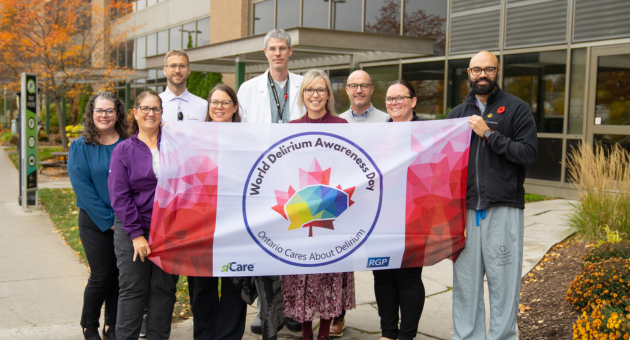
Team LHSC members hold the Ontario Delirium Flag outside of Victoria Hospital
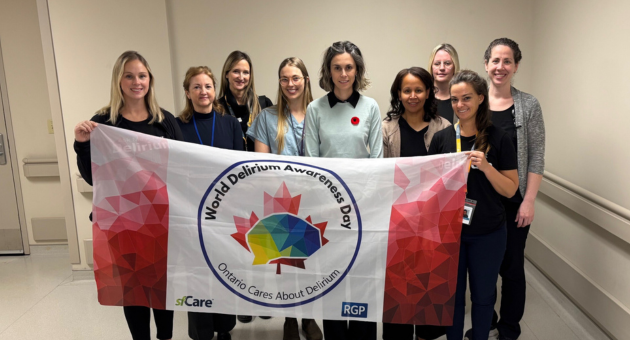
Team LHSC members hold the Ontario Delirium Flag at University Hospital