
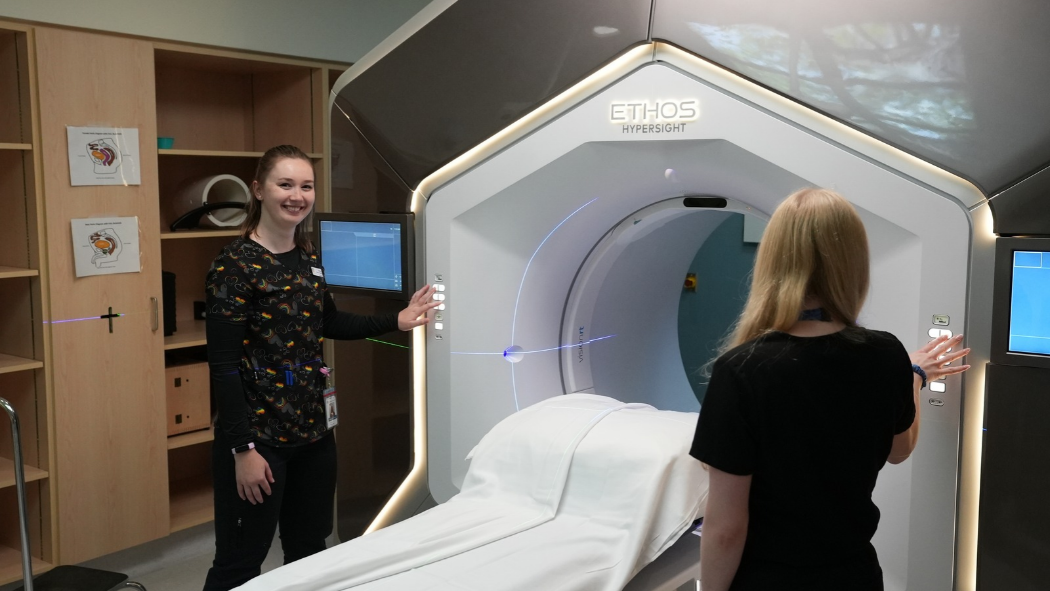
Photo from left: Meghan Koczwara and Christine Rossi, radiation therapists in the Verspeeten Family Cancer Centre preparing the Ethos linear accelerator (used to deliver radiation therapy) for a patient.
October 26, 2026
After only twelve weeks, beginning in March 2026, the Radiation Therapy team at London Health Sciences Centre (LHSC) Verspeeten Family Cancer Centre improved radiation therapy wait times by 34 per cent.
Some key figures to keep in mind:
- The target for patient wait times for this project is measured from when a patient is considered ready to treat to the start of radiation treatment.
- This project also included the target for patient wait times at LHSC from first consultation to the CT simulation appointment, which is three days. The CT simulation appointment is often the first step in planning for radiation therapy treatment, is three days.
- The provincial benchmark is for the patient to be treated within their urgency category wait time window. The target for most patients is to begin treatment within a wait time window of 14 days from being ready-to-treat. And within that, the aim is that at least 85 per cent of patients should be starting their treatment in that period.
- After the Radiation Therapy team implemented RESET into their workflow in August 2026, they saw 90.7 per cent of patients meet their wait time target from ready-to-treat to receiving their treatment.
Examining long wait times
When leaders in Radiation Therapy closely examined patient wait times for radiation treatment and CT simulation appointments, they noted that the issue was not about individual performance.
“Everyone was working hard and following the processes available to them. The team initially expected the system to self-correct as pressures changed from day to day, but a deeper investigation revealed that was not happening. Instead, delays were occurring throughout the pathway, creating barriers that prevented patients from moving efficiently from consultation to treatment,” explains Carina Feuz, Manager, Radiation Planning in the Verspeeten.
There were six areas that the team needed to focus on to improve these wait times:
- Demand and backlog management
- CT simulation
- Treatment planning
- Treatment delivery
- Stabilizing the roles of staff and ensuring their well-being
- Accountability and reporting as the project progressed
The three main goals of the project were:
- Reduce patient demand where appropriate
- Increase capacity where needed
- Improve patient flow through the treatment pathway
Dr. David D'Souza, Division Chair/Head of Radiation Oncology at the Verspeeten notes that there are multiple steps and collaborators that work in the cancer centre to get patients assessed and started on radiation.
"The 14-day target was set to ensure that across Ontario, there was equitable and timely access to radiation," D'Souza explains. "Our performance at the Verspeeten is measured and compared with other centres in the province. The rationale is that an adequately resourced system should be able to do the work required to get a patient started on treatment within that target. Longer waits can lead to poorer treatment outcomes. The importance of including the CT simulation appointment in this project is that it is the first step in getting patient to treatment. If a patient waits more than three days, it becomes challenging to “catch up” and get a patient started on time."
Feuz explains, “We recognized there were opportunities for improvement. It wasn’t about any one person or one team. It was about understanding how the entire pathway was functioning and where we could make changes together.”
Implementing RESET
The Radiation Efficiency Scheduling & Execution Transformation (RESET) launched in March 2026 in response to patient wait times that were longer than the provincial target for Urgency Three patients – which are patients that should receive their first treatment within 14 days from their ready-to-treat date.
The other categories are Urgency One patients, who should receive their first treatment within one day from consultation, and Urgency Two patients, who should receive their first treatment within seven days from their ready-to-treat date.
Working in partnership with LHSC’s Project Management Office, the initiative used data and insights from staff to identify practical changes using existing resources to reduce bottlenecks, restore timely access for patients, and create a more sustainable operating model of care.
“Rather than simply scheduling appointments as space became available, teams began focusing on whether patients moving through the system were truly ready for the next step in their treatment journey,” Feuz says. “And CT simulation booking was aligned more closely with treatment readiness, helping create a smoother and more predictable flow.”
Early indicators helped leaders and frontline staff understand when trends were emerging and what actions were required. If a change appeared to be part of a larger pattern, leaders determined whether they should stay the course, activate contingency plans, or take more direct action. This disciplined approach helped create a shared understanding across the pathway and increased clarity around decision-making.
The program established clear rules to review cases as the patient moved through each stage of care. These reviews helped identify barriers, adjust bookings when necessary, and ensure patients continued progressing through the system in a timely manner.
“If ready-to-treat performance started to decline or shift, that served as a signal for us to respond,” Feuz says. “Each threshold had a specific action associated with it, which meant we could monitor access delays and intervene before a backlog was established.”
A team effort
Clerks, physicians, physicists, radiation therapists, dosimetrists, electronic technologists, and leaders all had a role in helping patients move more efficiently through the pathway.
“The numbers were important,” Feuz notes, “but what mattered most was how the plan was implemented across the program and the positive impact it had on patient access to timely care.”
"The impact of RESET has been huge," shares Dr. D'Souza. "Since many of our patients travel for over an hour to get to our centre, in addition to convenience, these changes have made it easier for a patient to access the resources needed in a timely manner in order for them to receive radiation treatment. There is more flexibility in getting patients booked into a time slot that works for them. It also means that those suffering with symptoms like pain are getting relief sooner."
There were honest conversations throughout the process, and staff feedback was sought before, during, and after implementation. Many of the improvements that contributed to the program’s success came directly from frontline teams.
“A lot of the changes were staff generated,” says Feuz. “The success of RESET was because of the team here in Radiation Therapy. It was a huge team effort. We would not have achieved this success without everyone’s commitment.”
Patient care remained the focus
The shared goal was never simply to improve a metric. It was to ensure patients received the care they needed without unnecessary delays.
“We wanted patients to remain at the forefront,” Feuz says. “That’s why we were doing this. We wanted them to receive the best care possible and to receive it in a timely way.”
It is important to recognize that growth continues across both patient volumes and in terms of complexity of the patients the Verspeeten sees. Planning for additional capacity remains a critical component of the cancer centre's strategy.
Today, the Radiation Therapy team continues to monitor trends, review indicators regularly, and escalate concerns before they become larger issues.
RESET has demonstrated that sustainable improvement comes not from any single metric or intervention, but from a shared commitment to keeping patients moving through their care journey and ensuring timely access to treatment when it matters most.
"While the data shows improvement in access times, the true success of RESET can be measured in the experience of patients”, Feuz shares. "By identifying issues earlier, responding to trends proactively, and working together across the entire radiation therapy pathway, the team has helped ensure more patients receive the care they need, when they need it. And that remains the goal moving forward."