
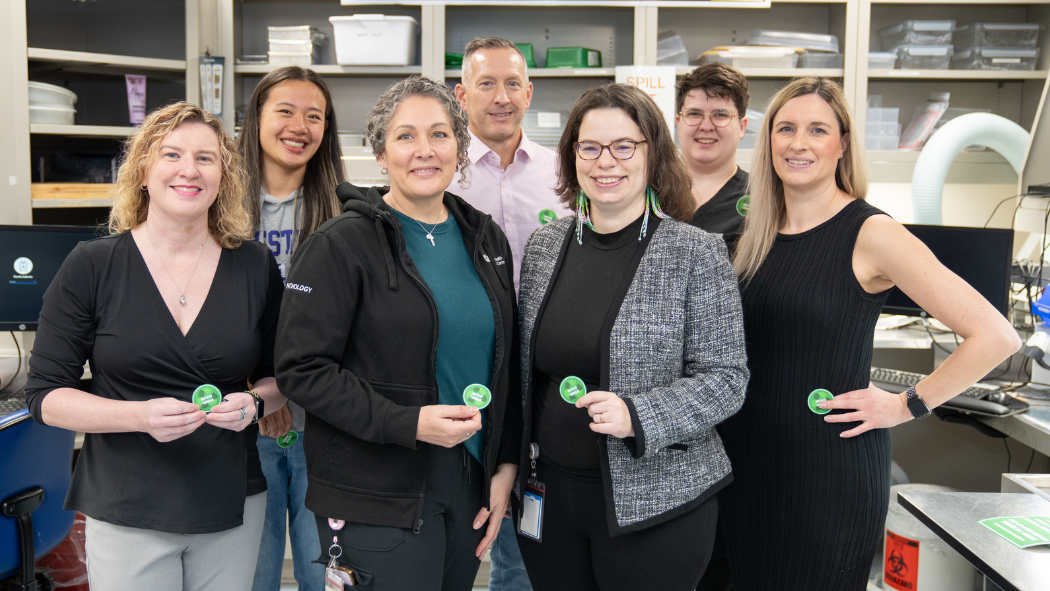
Above: Several members of the Pathology team, including (from L-R) Kathilyn Allewell, Maggie Chen, Elizabeth Marra, Tom Burberry, Dr. Rebekah Jacques, Alyx Kawai, and Rebekah Trerise.
April 22, 2026
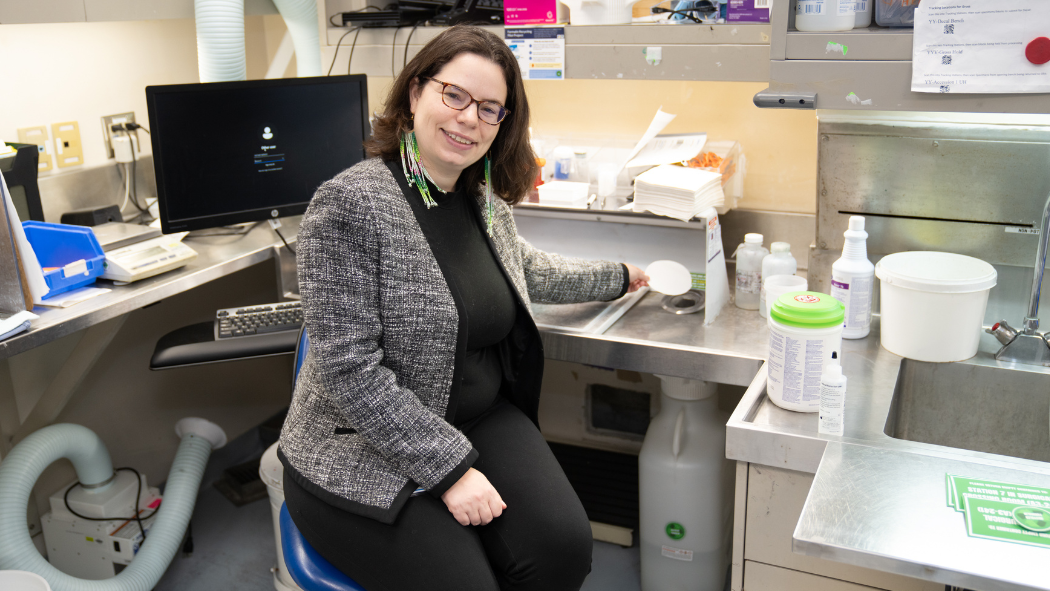
Dr. Rebekah Jacques, a Forensic Pathologist at London Health Sciences Centre (LHSC), has been recognized with a national Green Lab Award for leading a series of innovative sustainability initiatives within the Pathology Autopsy service. Each year, the Canadian Association of Pathologists (CAP-ACP) acknowledges a Canadian laboratory for its sustainability initiatives. Dr. Jacques is being recognized for a collection of projects that are reducing waste, lowering carbon emissions, and inspiring change at LHSC and beyond.
Dr. Jacques says the recognition highlights both the urgency and opportunity for greener health care.
“It’s wonderful to see this work acknowledged at the national level,” she says. “I hope it inspires others across LHSC to take on similar initiatives. We know that hospital work increases greenhouse gas emissions and that affects both the planet and our patients. We have a duty to make health care more sustainable.”
Four projects, one goal: A more sustainable autopsy service
Pathology is a high impact area of health care when it comes to chemical use, energy consumption, and single-use materials. To address this, Dr. Jacques and a multidisciplinary team launched four targeted projects aimed at rethinking everyday practices and reducing environmental impact.
- Reusing expired gloves
Working with the LHSC Green Team and Second Chance Supplies program, the team was able to use expired surgical and nitrile gloves in autopsy procedures that do not require sterility. This helped divert roughly 5,000 gloves back into use within the first two months while maintaining safety and quality standards.
- Launching a formalin recycling pilot
Last year, the Pathology and Laboratory Medicine (PaLM) department generated over 18,000 kg of formalin waste, which is equivalent to the carbon emissions of driving in a car 2.3 times around the Earth’s equator. Supported by the Environmental Action by Residents and Trainees for Health (EARTH) Initiative, the team adapted a validated protocol to filter and reuse clear formalin from surgical biopsies for autopsy work.
- Reducing biomedical waste through waste audits
Historically, all waste from autopsy suites was disposed of through a biomedical waste stream, a practice that is more financially and environmentally costly than some alternative forms of disposal such as landfills and recycling. Audits of the waste generated by the unit helped the team identify misclassified items and reduce unnecessary sterilization of non-hazardous materials. While maintaining infection control and regulatory compliance, the team was able to reduce biomedical waste from 91 per cent to 26 per cent. Sustaining this approach for one year could prevent more than 1,400 kg of CO₂ emissions, which is roughly equivalent to the emissions of a car driving from coast to coast across Canada.
- Cutting down on cassette waste
A year-long review of tissue cassettes – small, rectangular plastic boxes designed to hold and label tissue specimens – helped the team develop new, more sustainable workflows. Routine autopsy practices involved printing 20 cassettes per case, regardless of the number of blocks required. The three new proposed workflows will help pathologists print only what is needed based on the autopsy type, reducing unnecessary printing and waste generation.
Guided by Indigenous planetary health
As a citizen of the Métis Nation, Dr. Jacques views this work through an Indigenous planetary lens that emphasizes reciprocity, shared responsibility, and protecting resources for future generations.
She notes that the Dish with One Spoon Wampum, an agreement initially between Indigenous Peoples on the land LHSC now resides, is significant because it represents the shared use of the land’s resources. The dish represents the land and all the natural resources that people must share peacefully; the spoon represents that each person must only take what they need. The agreement reinforces the principles of shared responsibility-based friendship and ensuring the “dish” remains clean for all who share it in the past, present, and future.
“We won’t always be here,” she says. “There’s going to be future generations, and we need to be good ancestors for them.”
Collaboration at the core
Dr. Jacques emphasizes that the work would not have been possible without broad collaboration across LHSC, including Environmental Services, the LHSC Green Team, and student and resident partners. Frontline staff in PaLM worked together to solve problems and ensure solutions fit naturally within existing workflows. Dr. Jacques describes this collaborative process as a highlight of the work.
“If you are a relational person, it gives you an opportunity to meet people at LHSC that you otherwise wouldn’t meet in your day-to-day practice,” she says. “It was so cool because you see the problem one way and someone else sees it differently, and that collaboration is the sweet spot for me.”
Next steps: Making sustainable practices the norm
The initiatives were all launched within the past year, and the team is now focused on institutionalizing the changes through updated standard operating procedures. That includes sharing their protocols so other hospitals can easily adapt.
For health-care teams looking to get started, Dr. Jacques recommends beginning with small wins.
“Start with something simple. Once you get that first win, it gives you momentum. And if it’s not ideal the first time, try again.”