
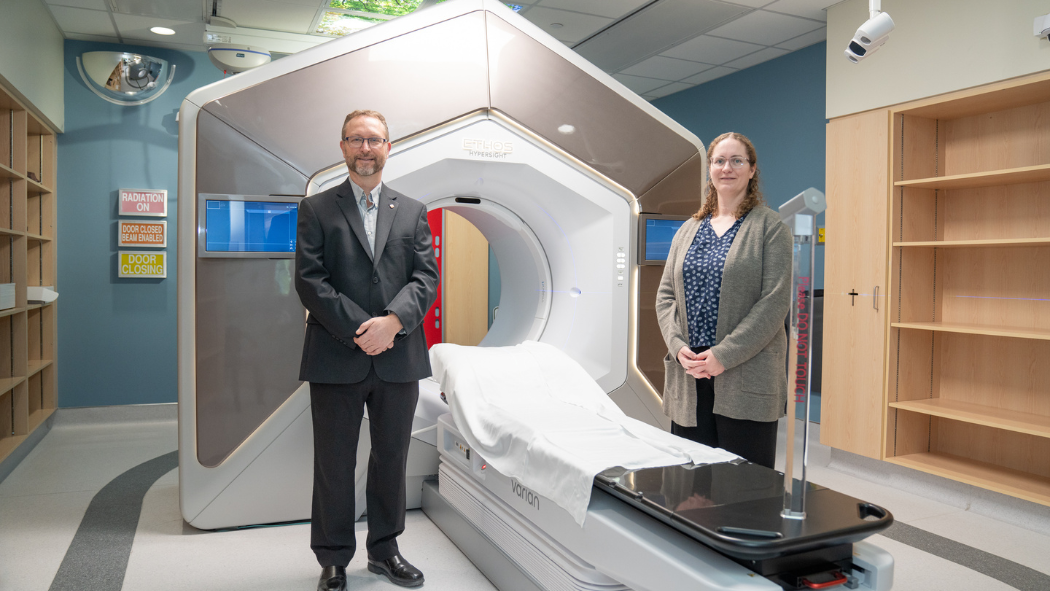
Photo: Dr. Stewart Gaede, PhD MCCPM, Chief Medical Physicist, LHSC Verspeeten Family Cancer Centre, Associate Professor, Departments of Oncology and Medical Biophysics, Western University, Associate Scientist, Lawson Health Research Institute, and Pamela Lepine, Manager, Radiation Treatment Delivery in Cancer Care with the Ethos Linear Accelerator in the Radiation department at LHSC’s Verspeeten Family Cancer Centre
December 1, 2025
In August 2025, London Health Sciences Centre became the fourth site in Canada to install an Ethos Linear Accelerator (LINAC) thanks to a generous donation from The Mitchell and Kathryn Baran Family Foundation, supported by Trudell Medical Limited. The Ethos LINAC has AI integration and enhanced imaging capabilities to provide more accuracy in the delivery of radiation treatment for cancer patients.
What is a linear accelerator?
Linear accelerators are machines that deliver high-energy particles to cancerous tumours while sparing healthy tissue. They have been used for decades to treat solid tumours and some blood cancers.
What makes the Ethos LINAC different?
The Ethos can detect changes in the body, such as tumour growth or patient weight fluctuations and can personalize and change the treatment plan as needed within minutes.
“With older LINACs, if there were changes, we couldn’t adapt treatment when the patient was on the bed. We had to get the patient up to receive another CT scan to get a new image of the tumor and then go through the process all over again of looking at the tumor to see if it grew or shrank, see whether the patient had lost or gained weight, and then redevelop the treatment. ” explains Dr. Stewart Gaede, PhD MCCPM, Chief Medical Physicist, LHSC Verspeeten Family Cancer Centre, Associate Professor, Departments of Oncology and Medical Biophysics, Western University, Associate Scientist, Lawson Health Research Institute. “The complexity of redeveloping new treatment would take days to a week to redo within traditional workflows, but now, with the Ethos, we are able to do the same work in minutes.”
The Ethos also produces high-quality images in as little as six seconds.
Dr. Gaede notes that in the mid-2000s the LINAC machines were equipped with onboard imaging systems so the provider could see images of the patient’s anatomy that were good enough to make sure they were hitting the right spot with radiation. “But now, the Ethos LINAC has the latest in AI to automatically segment the image to define organs, so if there are treatment plan adjustments that need to be made, they can be done in the moment.”
How the Ethos LINAC will improve patient care in the Verspeeten
Along with an improvement to workflows and imaging for providers, there are potentially fewer side effects when using the Ethos LINAC compared to previous LINAC machines.
Dr. Gaede explains why there maybe fewer side effects when using the Ethos - “If we can adapt the plan in the moment, we can better target the tumour and spare healthy tissues surrounding it. This means that there is less toxicity and fewer negative effects from the radiation as a result.”
The comparison between the use of older LINAC machines and the Ethos LINAC can be made using an analogy of getting fitted for a custom suit, says Dr. Glenn Bauman, Radiation Oncologist, Cancer Care at LHSC.
“Our traditional technology is like going to the tailor, getting measured for a suit and wearing it every day for four weeks. We have good tools to monitor the fit of the suit over the weeks of treatment, but we have to hope your weight or body shape doesn’t change in those four weeks,” Dr. Bauman says. “With the new technology, we basically make you a new suit before treatment each day so we can make sure that your suit fits perfectly each day!”
Along with treatment tailored to the patient in a way that produces fewer negative side effects, Pamela Lepine, Manager, Radiation Treatment Delivery, Cancer Care at LHSC says that using the Ethos also improves the patient experience before they come to the appointment noting that, “With the Ethos’ ability to adapt the plan to the patient in the moment, this can relieve some stress for patients as they prepare for appointments.”
“The Ethos is important for treating cancers that change during treatment or in areas of the body where the anatomy may change day to day, like the upper abdomen due to changes in the stomach and bowels,” shares Dr. Bauman. “This technology offers us ways to deliver radiation in these hard-to-treat areas using improved imaging, customized, in-the-moment treatment plan adjustments, reduced side effects and increased control in dosage.”
Lepine continues saying that this new technology being available to patients in our region is an opportunity to be a leader in radiation treatment delivery in cancer care. “It looks like this machine is the future of radiation therapy with customized plans for each patient and we are excited to be able to provide this next level type of care to our patients in southwestern Ontario.”