
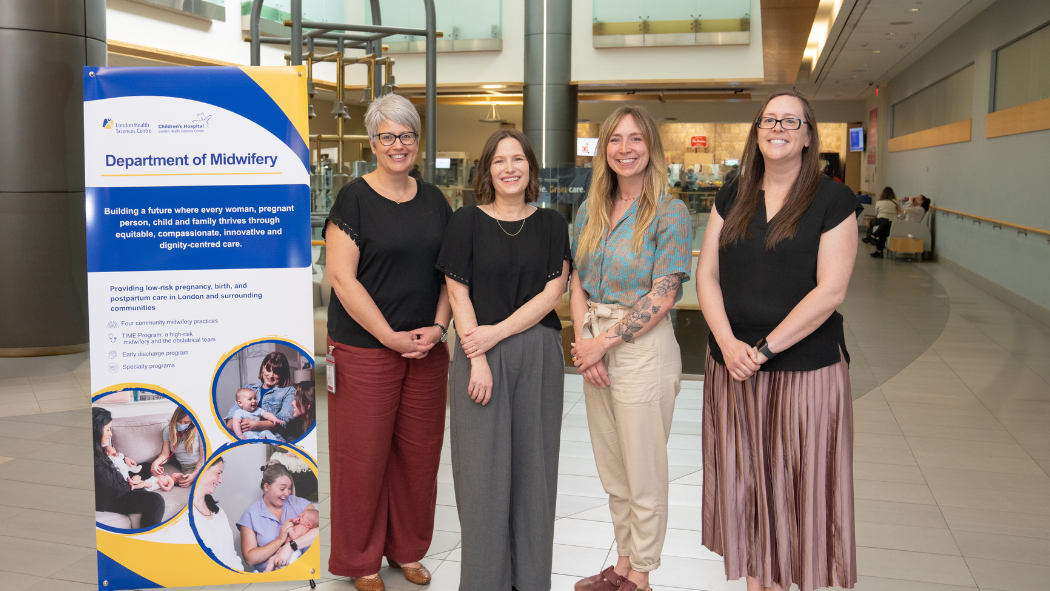
London Health Sciences Centre (LHSC) midwives, Jackie Droogers, Lauren Columbus, Elle Hoekstra, and Natalie Taylor.
May 5, 2026
For families navigating a high-risk pregnancy, the journey can sometimes feel challenging, from the frequent appointments, the demands of newborn care, and an added layer of uncertainty when returning home after birth.
For Sara Celik, that experience came with an added layer of complexity. After undergoing fertility treatment, she learned she was expecting twins, Dafne and Ela, and knew her pregnancy would require close monitoring.
“As someone who works in women's health and fertility, and who personally went through fertility treatment to conceive my twins, this pregnancy journey meant a great deal to me,” Celik says.
When her obstetrician/gynecologist (OBGYN) told her she was eligible for The Interprofessional Midwifery/Maternal-Fetal-Medicine (MFM) Expanded (T.I.M.E.) Program, she didn’t hesitate to take part in the program.
“I was genuinely thrilled,” says Celik. “I had a midwife with my son almost five years ago and had such a positive experience, so being able to access that level of care again, while also being closely monitored by specialists, felt like the best of both worlds. I said “YES” immediately.”
A growing model of care
Since launching in 2022, The Interprofessional Midwifery-MFM Expanded (T.I.M.E.) program has continued to grow, supporting approximately 170 families each year, with demand steadily increasing. In 2024, expanded funding through Ontario’s Ministry of Health increased its capacity by nearly 40 per cent, reflecting both need and impact.
The program brings midwives and Maternal-Fetal Medicine (MFM) specialists together to support patients before, during and after birth—offering not only clinical care, but reassurance and time.
Traditionally, patients with high-risk pregnancies move between multiple care teams throughout the pregnancy, but the T.I.M.E. program was designed to change that.
At LHSC, midwives work alongside MFM specialists in the same clinic space, allowing patients to see both providers in a single visit. While specialists focus on complex medical care, midwives have time to answer questions about feeding, recovery, mental health and life with a newborn.
“We often see patients come to us with long lists of questions about the ‘normal’ parts of pregnancy and becoming parents,” says midwife Lauren Columbus, Academic Practice Lead. “That’s where we’re able to spend time providing personalized education and building a plan that supports them beyond the hospital.”
The additional time and support makes a meaningful difference for patients including Celik.
“The midwives answered so many of my questions about delivery, feeding, recovery, and managing twins once they arrived,” she says. “Without the T.I.M.E. program, I likely would have been searching for answers myself. Instead, I felt genuinely cared for and supported.”
Expanded capacity has also allowed the team to introduce free prenatal education classes tailored to high-risk pregnancies. Offered both in-person and online, the sessions are often fully booked, with waitlists for most classes.
Care that continues at home
One of the most defining features of the T.I.M.E. program is what happens after patients leave the hospital, when many families need support the most.
Eligible families can be discharged early, often within 24 hours of birth, and will continue receiving care at home from a midwife for up to six weeks postpartum.
“They don’t have to pack up their newborn, leave the house, and navigate appointments while they’re still recovering,” says Columbus. “We come to them. And we tailor that care based on what they need.”
That support was invaluable for Celik, who delivered her twins via C-section on March 26.
“I only stayed one night in the hospital,” she says. “After that, the midwives came to our home every two days checking the babies, supporting breastfeeding, monitoring for jaundice, and even doing bloodwork so we didn’t need to go back.”
Recovering from surgery while caring for two newborns can be overwhelming, but having care come to her made a significant difference.
“Packing up newborn twins for appointments would have been so difficult,” she says. “Having expert care at home made recovery far more manageable.”
It’s a model that not only improves patient experience but also eases pressure on the broader healthcare system by reducing emergency department visits and readmissions.
Filling critical gaps in care
While the T.I.M.E. program supports a small portion of LHSC’s more than 6,600 annual births, it focuses on patients disproportionately impacted by factors such as income, housing, mental health and access to resources.
“These are patients who often face additional barriers,” says Columbus. “Our role is to help bridge those gaps so they can have better outcomes.”
That includes tailored prenatal education, mental health support, and hands-on breastfeeding care in the critical early weeks.
In many cases such as Celik’s, the support extends beyond physical care.
“Anyone who has gone through fertility treatment knows that anxiety can remain high even after you conceive,” she says. “Having a trusted care team made a tremendous difference. It helped me feel grounded, informed, and supported throughout pregnancy and postpartum. Having my midwife, Elle, there to walk me through each step made all the difference.
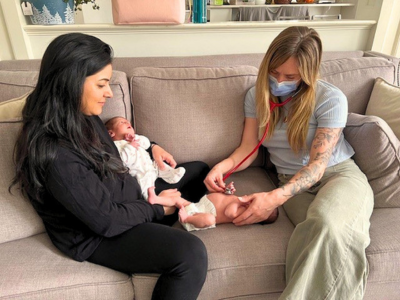
Celik also credits the program with helping her feel more confident as a new parent of twins. “I never once felt rushed. Every question was welcomed and answered thoroughly,” she says. “To feel informed, cared for, and supported during such a vulnerable time is something every mother deserves.”
Looking ahead
As the program continues to grow, the team hopes to expand its reach even further and bring this model of care to more families across Southwestern Ontario. Ongoing evaluation work in partnership with Western University is helping to measure outcomes and better understand the program’s long-term impact.
Early program data reflects meaningful impact. Breastfeeding rates among T.I.M.E. patients increase from 38.2 per cent at hospital discharge to 50.4 per cent at six weeks postpartum which is an important distinction, as rates typically decline during that same period across Canada.
The improvement is attributed in part to the program’s six weeks of in-home breastfeeding support, delivered during the most critical period for establishing feeding.
For the providers involved, the work is deeply meaningful.
“It’s a privilege to walk alongside families during such an important time in their lives,” says Columbus. “We’ve supported people through incredibly joyful moments, and also through loss and grief. Being able to provide that continuity of care and to really be there for them is what makes this work so rewarding.”