
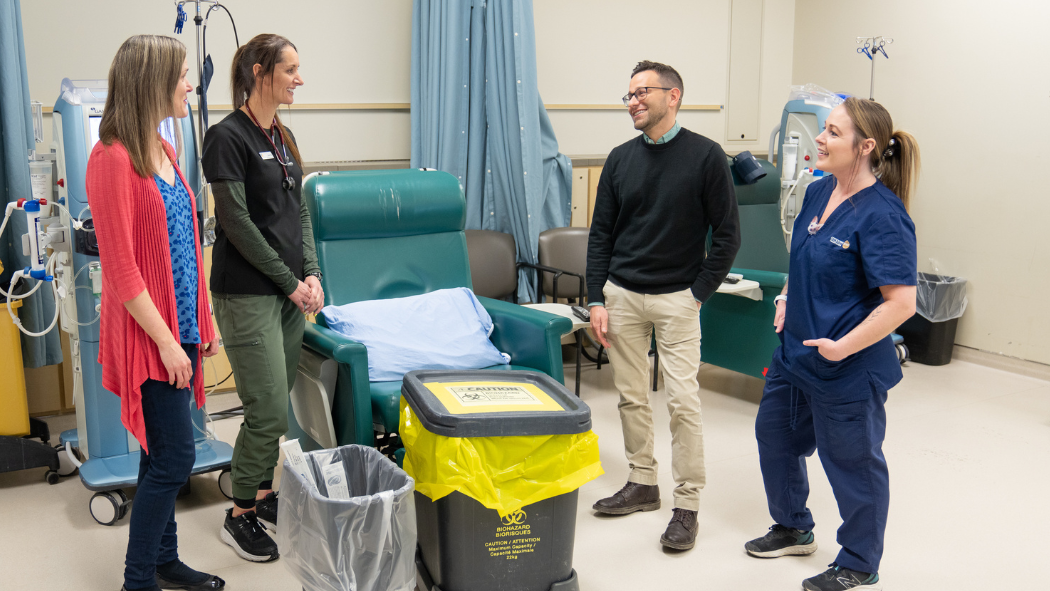
Photo from left: Melissa Costella (Manager, Renal Program), Laura Tait (Charge Nurse, Westmount Dialysis Unit), John Vecchio (Environmental Waste Specialist, Facilities Planning & Design), and Kayla Delaney, Housekeeper (Compass One) discussing the new hemodialysis waste process.
March 12, 2026
The Regional Renal Program at London Health Sciences Centre (LHSC) has updated their waste disposal process for hemodialysis treatments to become more environmentally friendly and sustainable.
The program looked at their current waste disposal process and the costs involved for disposing items such as bloodlines and dialyzers into biohazard waste bags after a team member noted that home hemodialysis patients are able to put their tubing and packaging in their garbage at home. When leadership connected with other renal programs in the province, it was confirmed that some other programs put non-blood saturated waste – which is waste that has come into contact with blood - into general garbage.
This process change was done following guidelines found within the Environmental Protection Act (C-4 The Management of Biomedical Waste in Ontario) which specifically exempts dialysis waste that is not saturated in blood from being classified as biohazardous waste.
Once the Renal team learned they were overclassifying much of their waste as biohazardous, the Renal and Facilities teams were able to work together to ensure the waste the Renal teams were generating was ending up in the proper waste stream.
“Our Regional Renal Program is supportive of efforts to continue to assess and support improvement initiatives, including impacts on the environment,” shares Terri Chanda, Director, Regional Renal Program. “Renal programs produce a lot of waste so considering ways to reduce our carbon footprint is supported both at a local and provincial level.”
A collaborative approach to waste process improvements
“Our team used a collaborative PDSA approach (plan, do, study act) for the waste process improvement including nurses, Environmental Services, educators, leaders and Facilities. For example, we trialed a few different options for how best to optimize the waste collection process and receptables in our dialysis units. Factors included weight of the lines, nurse workflow, Environmental Services workflow, weight that could be supported by the Environmental Services’ cart, etc. Based on input from team members, we ended up using regular garbage cans, double bagged, to dispose of the non-blood saturated waste, as patients use the regular garbage cans, since they need to be emptied after each treatment anyway,” explains Melissa Costella, Manager, Renal Program, LHSC.
Working with Environmental Services staff, the Renal Program changed their practice, as of December 2, 2024, from disposing non-blood saturated waste as biohazardous waste to general waste (double-bagged) at their centres in University Hospital, Victoria Hospital, Westmount Shopping Centre, St. Joseph’s Parkwood Institute, Regional Resource Unit, Home Hemodialysis and Peritoneal Dialysis units. The items that are now thrown away as general waste are:
- Dialysis tubing (non blood saturated, infectious, or cytotoxic)
- Packaging
- Gloves
- Personal Protective Equipment (PPE)
- Unsaturated syringes (without needles)
John Vecchio, Environmental Waste Specialist, Facilities Planning & Design, LHSC supported the Renal teams as they changed their waste disposal process for these items.
As an Environmental Waste Specialist, Vecchio helps ensure that LHSC maintains compliance with Ministry regulations for waste management and transportation of dangerous goods (which includes biohazardous waste). These specialists are responsible for creating, implementing, and sustaining a waste management system designed to maximize waste prevention and recycling opportunities within the organization.
Not only is general waste and biohazardous waste delivered to different facilities in the province, but there is a functional difference that results in a cost variation between the two processes.
“Biohazardous waste may contain infectious agents and therefore the treatment, transportation, and disposal of this waste is regulated by the Ministry of the Environment, Conservation and Parks, and Transport Canada,” Vecchio explains. “Since general waste does not pose the same risks, it can instead be sent right to the landfill.”
The extra steps needed in the transportation and treatment of biohazardous waste have a negative impact on the environment.
“The process of autoclaving (a sterilization method) and incinerating biohazardous waste produces carbon emissions,” Vecchio notes. “But if we send plastic waste that does not emit much greenhouse gas to a landfill as general waste, and that landfill practices methane capture – which means the greenhouse gas is collected and used for energy instead of being released in the air – that also further reduces our carbon footprint.”
The positive impact of this change in practice
The main benefit of this initiative is the reduction in carbon emissions.
“The non-hazardous medical waste that’s being diverted to general waste is largely made of plastic. When it is put into a landfill, it produces less emissions than if it were to be autoclaved or incinerated as biohazardous waste. Basically, a landfill acts as a permanent storage site for medical plastics, whereas burning them releases carbon into the air,” Vecchio shares.
There is also a financial benefit for the organization in diverting this waste from biohazardous to general waste.
“Biohazardous waste costs more to dispose of than general waste, so by diverting waste that does not need to be treated as biohazardous, we are able to save on the costs of disposing that waste,” says Vecchio.
This collaboration across the Facilities, Environmental Services, and Renal Program teams has resulted in cost savings and a reduction in LHSC’s carbon footprint.