
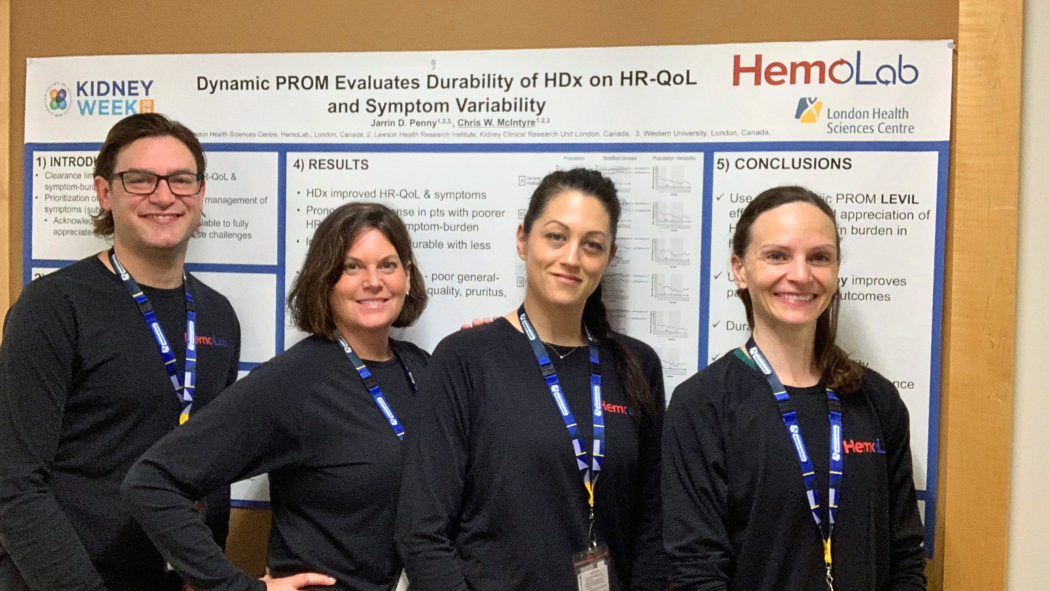
From left to right: Justin Dorie, Jarrin Penny, Tanya Tamasi, and Amy Freeman.
May 14, 2026
For many patients, especially those receiving dialysis treatment, some of the research happening at London Health Sciences Centre Research Institute (LHSCRI) impacts their experience of living with a chronic disease. This research is about improving quality of life, and in general, making treatments more tolerable and helping patients feel more like themselves again.
Behind that work is a nursing team bringing their clinical expertise, research proficiency, and compassionate care into every study they support.
As LHSC celebrates Nursing Week and this year’s theme, “The Power of Nurses to Transform Health,” a team of nurses working in kidney and cardiovascular research have been highlighting the important role nurses play in advancing research and innovation in health care, continuing to build knowledge.
“We got here because we are nurses,” says Jarrin Penny, RN, PhD and leader of the clinical team. “We bring the same caring aspect to our jobs in research that we brought to patient care elsewhere.”
Working alongside Principal Investigator Dr. Christopher McIntyre, the team supports research focused on kidney disease, dialysis, and heart failure. Their work includes studies exploring ways to reduce injury caused by hemodialysis, improve vascular and cognitive outcomes for patients, and lessen symptoms associated with dialysis treatment.
While the research can be very data-driven, the team says they bring a people-centered approach to the research that is shaped by their nursing expertise.
Justin Dorie, RPN and Research Coordinator, adds, “Our patients get our full and undivided attention and in return, they share their stories with us and it becomes a very impactful relationship for all of us. They seem to enjoy their time with us. They feel heard and respected and cared for, and they often come back for future studies.”
Team collaboration and expertise
The team includes both RNs and RPNs, each bringing different strengths, experiences and expertise to the work.
“We work incredibly well together and have a lot of respect for each other,” says Penny, a PhD-prepared nurse who brings her research know-how to the team. “Everyone brings something unique to the team, and our patients and our research benefit from that collaboration.”
Amy Freeman, RN and Research Coordinator, says the team’s diverse perspectives are one of its greatest strengths. Before moving into research, she spent years working across various cardiology units and says those experiences continue to shape the way she approaches research today. Currently pursuing her PhD, Freeman values the opportunity to contribute both clinical and research insight to the group’s work.
“I’m proud of this team and excited to be able to bring a different perspective,” she says.
For Tanya Tamasi, RPN and Research Coordinator, that collaborative environment is one of the most rewarding parts of the role. “I’m proud to be part of this team because we’re doing innovative work that can make people feel better and improve their lives,” she says. “I get to use my clinical dialysis skills, and I’ve also learned so much more in the research space. It allows us to think outside the box.”
Patient Impact
The team’s work ranges from supporting clinical trials to quality-of-life studies. One recent dialysis study examined whether expanded clearance dialysis treatments could reduce symptom burden and improve cognition, sleep, and overall quality of life for patients.
“We saw patients feel better when they were on the [different dialyzer] treatment,” says Penny. “Fatigue improved, sleep improved, and patients often described feeling clearer mentally. Those are meaningful outcomes for people living with chronic illness.”
Beyond collecting data and coordinating studies, the nurses say relationship-building is central to their work. Patients undergoing dialysis often visit the hospital multiple times each week, allowing strong therapeutic relationships to develop over time.
“Patients volunteer their time because they want to help others,” says Justin Dorie. “Many of them are incredibly grateful for the care they receive and want to contribute to improving care for future patients.”
The team says those relationships reflect something uniquely valuable about nursing perspectives in research.
“Nurses notice different things,” says Penny. “We often focus on the ‘smaller’ impacts that affect a patient’s quality of life, but those things aren’t actually small. They matter deeply to patients and families.”
The group also hopes to challenge outdated perceptions about what nursing looks like.
“There can still be a misconception that if you move into research, you stop being a nurse,” says Penny. “But we use nursing knowledge, clinical judgment, communication and patient-care skills every single day. Nursing exists in many spaces, and research is absolutely one of them.”
As Nursing Week recognizes the impact nurses have across the health-care system, the team hopes more people will recognize the growing role nurses play in research, innovation and shaping the future of care.
The team also acknowledges that change is coming and believes that nurses will be more empowered and better recognized for contributing to health care and the field of nursing through research.
“We are proud to be nurses,” says Penny. “And we’re proud that our work focuses not just on treatment, but on improving quality of life for patients. That’s what drives us.”