
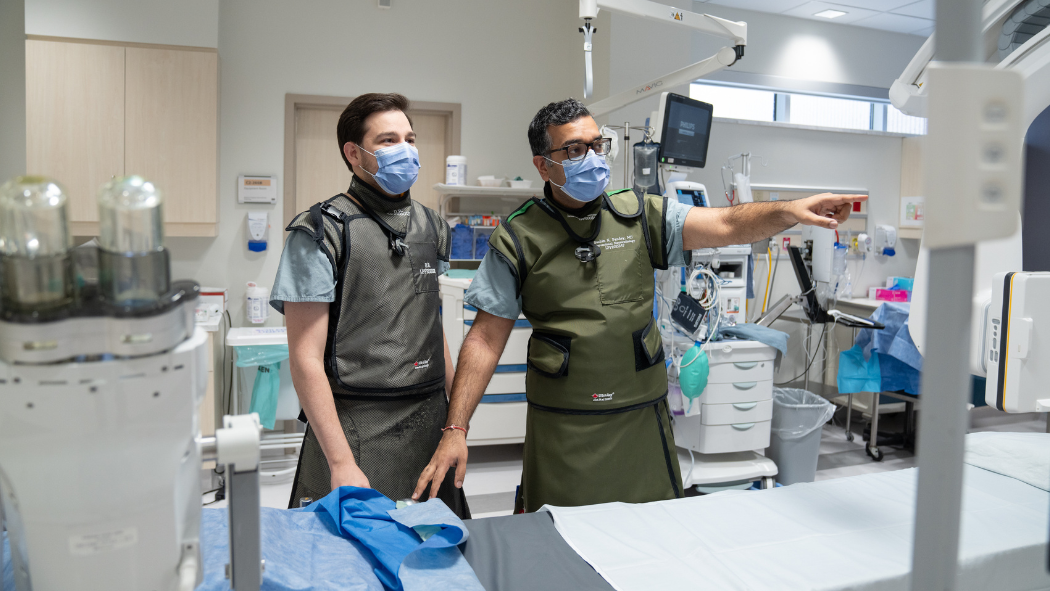
Image: Dr. Gabriel Mantovani (left) is the first fellow to study under the World Stroke Organization’s International Neurointerventional Fellowship. Studying under Dr. Sachin Pandey (right), he will bring knowledge and experience back to his home country of Brazil.
June 22, 2026
A new global fellowship is bringing physicians to London for advanced stroke training, with the goal of expanding access to specialized care in under-served regions around the world.
Dr. Gabriel Mantovani arrived at London Health Sciences Centre (LHSC) and Western University (Western) in 2025 as the World Stroke Organization’s (WSO) inaugural International Neurointerventional Fellow. The program trains stroke specialists from under-served regions and equips them with the knowledge and experience to expand access to life-saving care at home.
For Dr. Mantovani, the opportunity is deeply personal. Trained in neurology and stroke care in Brazil, he has seen how geography and resources can determine patient outcomes. In many regions outside major urban centres, specialized stroke care, like thrombolytic therapies and endovascular treatments, remain unavailable.
“Stroke care around the world is very unequal,” he explains. “In many countries, patients simply don’t have access to treatments that can save lives or prevent disability.”
By pairing world-leading training centres with talented physicians from these regions, the WSO fellowship aims to close that gap one fellow at a time.
Bridging the gap through education
The Charles Drake Clinical Fellowship in Neurovascular Therapy at Western’s Schulich School of Medicine & Dentistry was selected by the WSO as a host program for its new international fellowship, delivered in partnership with London Health Sciences Centre and supported by London Health Sciences Foundation.
Through the fellowship, Dr. Mantovani has trained in a dramatically different clinical environment than where he began his education, gaining experience in a high-volume, highly integrated stroke centre serving patients from across the region.
Under the leadership of Dr. Sachin Pandey and fellowship co-directors, Dr. Mel Boulton and Dr. Michael Mayich, the fellowship program brings together six interventional neuroradiologists, each with different training backgrounds and approaches, to offer exposure to multiple perspectives and techniques. Combined with advanced imaging technology and a coordinated regional stroke network, the environment provides an exceptional learning experience.
“Being in a centre like this, where hundreds of complex procedures are done every year, completely changes your perspective,” Dr. Mantovani says. “You not only learn how to conduct the procedures, but how to think about the disease, the system, and the patient in many different ways.”
Bringing knowledge home
When Dr. Mantovani’s completes the fellowship, he plans to return to Porto Alegre, Brazil, where he hopes to expand access to life-saving neurovascular procedures and introduce interventional techniques that are not yet widely available.
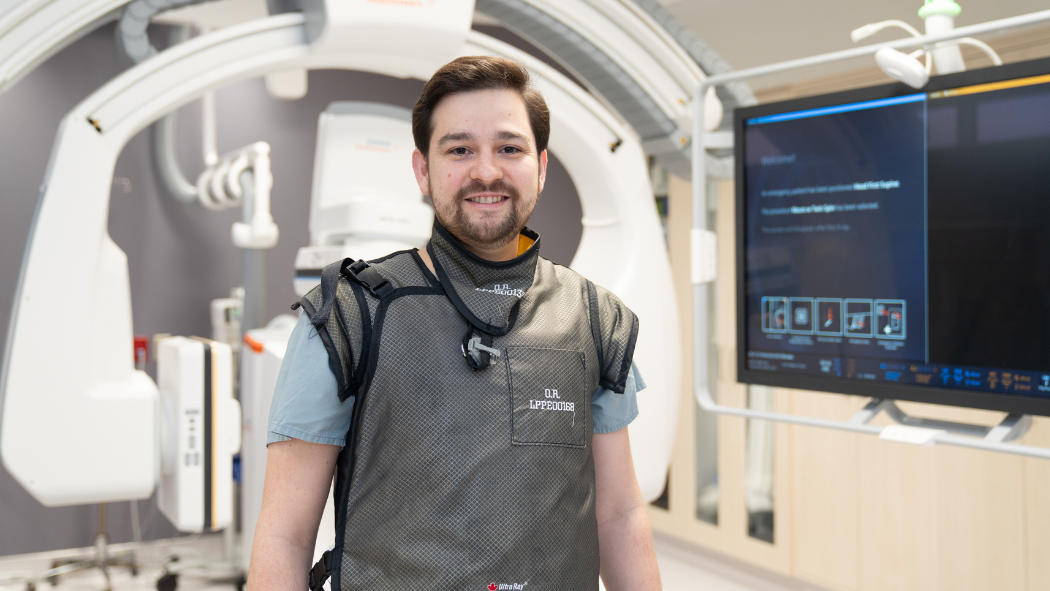
Image: Dr. Mantovani plans to expand access to life-saving neurovascular procedures and introduce interventional techniques in Porto Alegre, Brazil.
“The program is all about access and innovation,” he explains. “Stroke treatment is the core of our work, but there are many other conditions we can treat with interventional techniques that haven’t fully reached Brazil yet.”
He also envisions building long-term academic and clinical partnerships between Brazil and Canada by creating pathways opportunities for future trainees to learn at institutions like LHSC and Western.
An education with global impact
Dr. Pandey, associate professor and division head of diagnostic and interventional neuroradiology, credits Dr. Mantovani with thriving under the WSO's International Neurointerventional Fellowship.
“He’s been an incredible ambassador,” he says. “His clinical skills are razor sharp, and it is also impressive how he’s adapted to a new country, a new system and a very demanding program.”
The fellowship program also underscores London’s global leadership in neurovascular care and innovation.
“We’re proud of the care that we offer patients here in London,” says Dr. Pandey, “and just as proud that we can help extend that impact far beyond our borders.”