
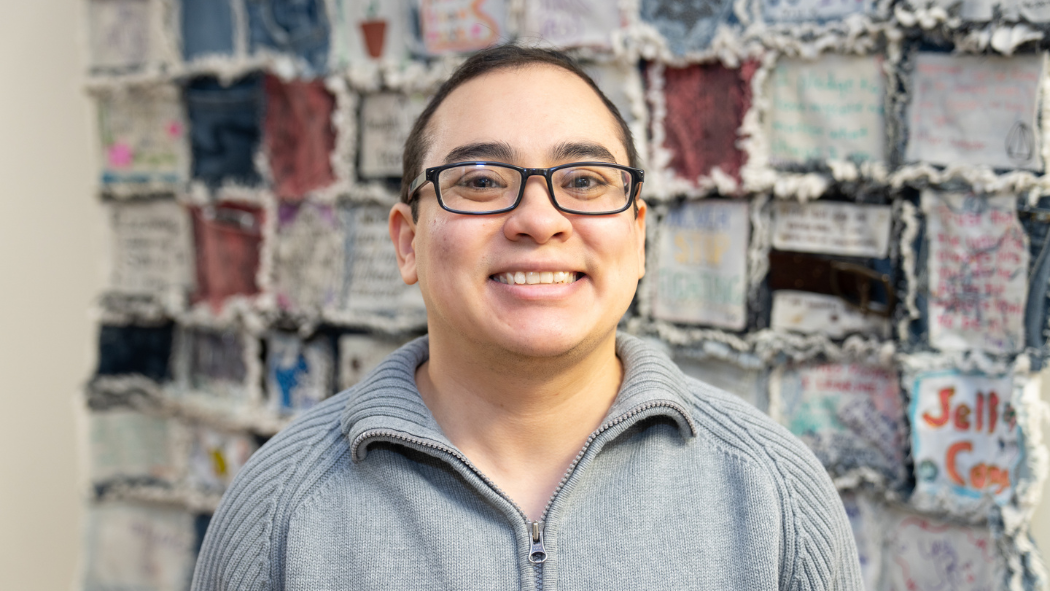
Christopher Keel, patient, in front of the jean quilt at the Adult Eating Disorders Service, LHSC. The quilt was made from old pairs of jeans from clients and staff. These were the jeans in a small size that people hoped to fit in one day, but were cut a part as a message that jeans do not hold power over them.
February 4, 2026
“The second time I sought help for my eating disorder, I was drawn to their outpatient offering because I was a university student and I didn’t want to compare myself to others who were also seeking treatment,” explains Christopher Keel, a recent patient of the Adult Eating Disorders Service (AEDS) at London Health Sciences Centre (LHSC).
Keel was diagnosed with anorexia 10 years ago when he was 18 years old. At that time, he became a patient in the day treatment program in the AEDS. After his time in the program, he remained in recovery for seven years, using the tools he was given to keep him on track. But symptoms of the eating disorder persisted.
“I hated my body, and experiencing distress associated with weight gain was difficult for me to address the first time I was in the program,” explains Keel. “I was restricting food to meet my goal weight, and when I met my goal weight, I still hated my body, and I realized I was looking at my body through a distorted view. While poetry and art helped me process some of this, I realized I needed help.”
The symptoms Keel was experiencing were diverse and sometimes contradictory. He was restricting food intake, felt nauseous, and was gagging frequently and would end up vomiting regularly. He didn’t like the smell or look of food and felt he could not taste it properly, describing it like his brain was telling him to not eat the food because it tasted awful, even when it was food he had previously enjoyed.
He experienced body checking, but also body avoidance, often comparing himself to others, and had a particular preoccupation with looking at thin people.
“On Instagram, I would follow thin people and look at them to fuel my eating disorder. And even though I was often disgusted by the look and smell of food, I would also look at pictures of food I wanted to eat, often gathering pictures of desserts,” Keel shares.
“This second time I went to treatment, I felt like I had better control of other aspects of my life and could give more focus to my eating disorder, since I had been struggling with it since I was about 14 years old,” says Keel.
Entering treatment a second time
It is common for some individuals who struggle with eating disorders to require supportive treatment multiple times in their lives. In subsequent treatments, patients can explore new ways to understand why the eating disorder persists and perhaps explore new resources and tools to help maintain a stable body image or weight moving forward. This was Keel’s experience.
After an initial assessment, it was advised that Keel participate in the outpatient program since that would best fit his needs – which is the program stream he was hoping for.
“I started individual therapy as part of my outpatient treatment, and I found it very helpful,” Keel says. “I was able to discuss my fears, what I was going through and dive deeper into what was fueling my eating disorder. My social worker was supportive and flexible and helped me feel comfortable.”
Since Keel was not underweight as he sought help with his eating disorder for the second time, he received a new diagnosis – Other Specified Feeding or Eating Disorder (OSFED). As part of his therapy, he not only received counselling, but education and tools on his eating disorder.
“The education was great. I was given information on the dangers of restricting food, and general information about eating disorders and how harmful they are to health. The information referenced studies and also explored other areas of mental health including emotional regulation, because restricting food isn’t just about body dissatisfaction, but is often tied to other negative emotions. We covered a lot of things educationally, like around core beliefs and how I came to believe what I do about body sizes,” Keel describes.
Support moving forward
Keel was discharged from the program in 2024 and has been doing well ever since.
As a part of therapy, near the end of his time in the program, he created short- and long-term relapse prevention plans and was reminded of what to look for if he experiences a lapse.
“It is typical for people with eating disorders to slip into old habits – that is incredibly common. But I was taught that it’s important to not focus on the slip; it’s about recognizing the slip and getting back on track with the tools learned in treatment. A part of what I worked on was my focus on perfectionism, which is something I noted in my long-term plan as a trigger to dismantle so it wouldn’t affect me as much,” explains Keel.
Another tool he learned when he was near discharge was “self-therapy.” This is when a person sets aside time to focus on eating disorder therapy for the self where they check in on themselves and reflect on their mental health and behaviours.
Since his discharge, Keel has been doing self-therapy, revisiting education information from his time in treatment, and using the tools he learned on a regular basis. He has also curated his social media account to focus more on his interests instead of content that may fuel his eating disorder.
“I revisit my self-therapy sessions when I start seeing the signs of slipping, like comparing myself to others, body dissatisfaction, thinking about restricting food, or being disgusted by food,” Keel says. “It’s helped me stay on track.”
Adult Eating Disorders Service (AEDS) at LHSC
The AEDS requires a referral from a primary care provider to enter their program. They have a new model of care that continues to be shaped by feedback from staff and patients.
“Between my first time at the AEDS and the second, I noticed improvements in the program and my second time was so much better,” shares Keel. “They are supportive and not only open to feedback, but they implement it.”
One of Keel’s pieces of feedback was to add Pride posters, stickers or flags to the AEDS space, so when new patients arrive, they know that the space is queer friendly and welcome, since queer patient populations experience high amounts of distress over body image. The next time Keel visited, he saw they had implemented his feedback.
Keel thinks that speaks to the level the practitioners at the AEDS listen to their patients and how they centre the patient experience. “My experiences at the AEDS have been helpful to me, and I will keep working to stay on the positive path they helped put me on.”