Step 2: Planning visit and insertion of central line
You will have another visit in the cancer center with your CAR-T medical team to assess your continued eligibility, as well as to receive further education and to schedule insertion of your central line.
You will also receive a detailed schedule of events and appointments, which your healthcare team will review with you and your primary caregiver.
Central line insertion
A central line is needed to collect your cells and will remain in place until you have recovered from your CAR- T therapy (can be six (6) to eight (8) weeks from start to finish).
Understanding Central Line Insertion
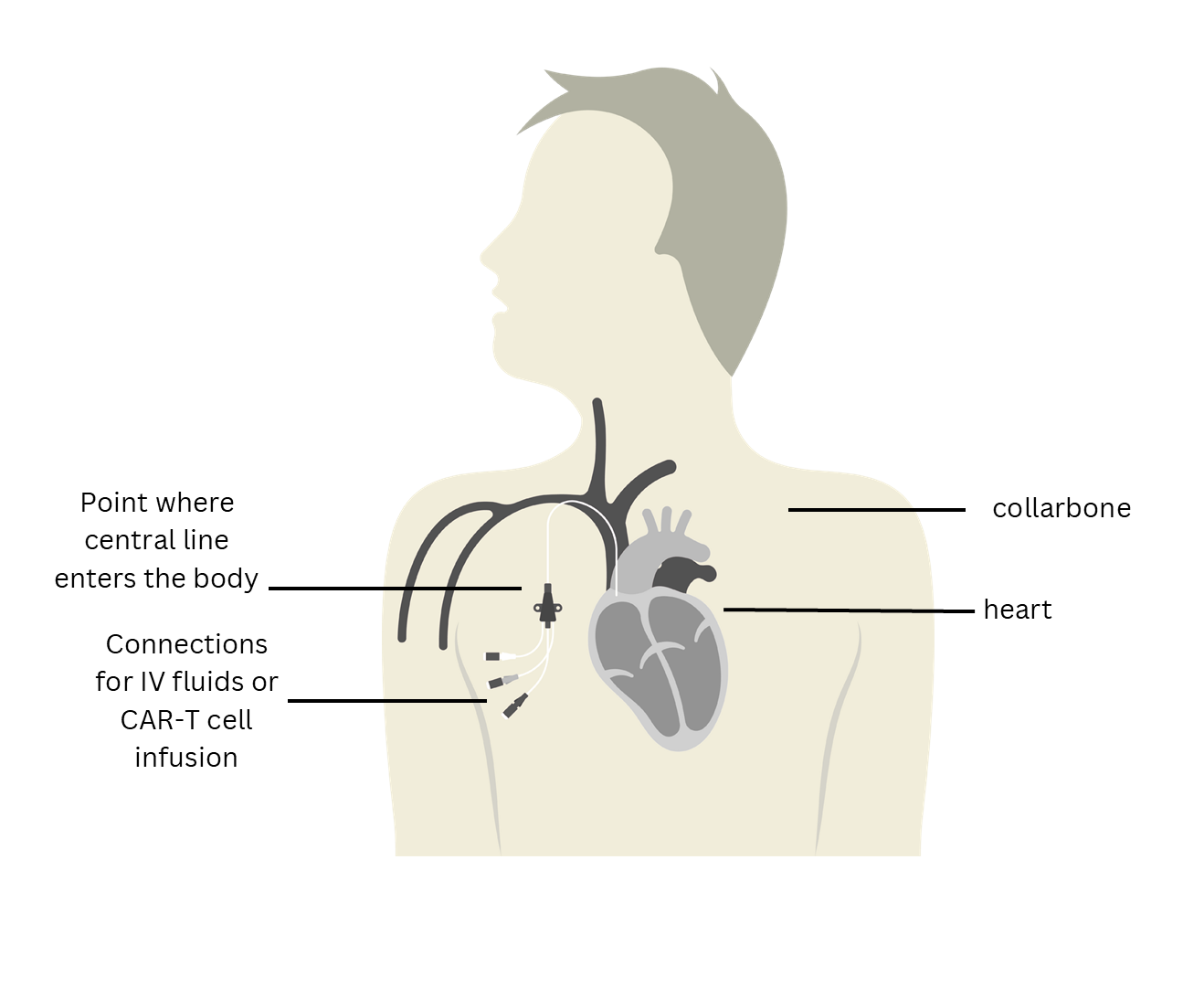
Image description
The graphic shows the upper torso of an adult with a medical central line inserted into a large vein in the upper chest. Thin tubing runs from the entry point near the right side of the chest toward the heart. Labels identify the collarbone, the heart, the point where the line enters the body, and the external connectors used for IV fluids or CAR‑T cell infusion. The illustration focuses on the pathway of the catheter from the chest into the heart.
During this minor procedure, you will get local freezing and mild sedation while the central line is inserted in a large vein near your upper chest.
Please arrange for someone to pick you up after this procedure.
Your Central Line will be used to:
- Get blood samples
- Collect your T-cells
- Give chemotherapy
- Receive your CAR-T cell infusion
- Provide other treatments such as blood transfusions, IV fluids, electrolytes, and antibiotics as needed
Your central line needs weekly dressing changes and flushing. Your CAR-T team will discuss how this will take place.
Before receiving CAR-T cell therapy, flushing is not to be done by community nurses, except for community dialysis nurses. Between T-cell collection and admission CAR-T infusion, you may need to come weekly to LHSC or the Windsor Cancer Program weekly for flushing done by trained nurses.
Central Line Complications
Please contact your healthcare team if you experience:
- Signs of infection, such as redness, pain, pus/drainage around your central line or if you have a fever (temperature of 38.0°C or 100.4°F or greater).
- If your arm swells on the side where your catheter was inserted. This can be a sign of a blood clot.