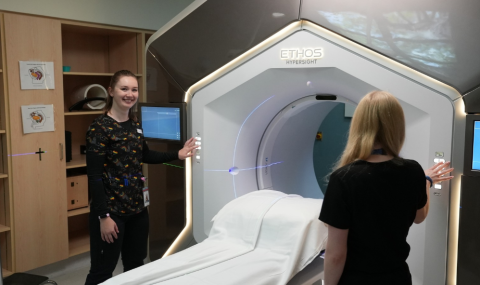
Our residents develop skills to practice competently as medical physicists, including commissioning equipment, implementation of new techniques, consultation in radiotherapy simulation, planning, and treatment, and equipment and patient quality-assurance. Example experiences include linac commissioning (Varian TrueBeam and Ethos), CT- and MR-Simulation, treatment planning on various platforms (Eclipse and RayStation), stereotactic radiosurgery, surface-guided radiation therapy and HDR- and LDR-brachytherapy.
Program Structure
Learning is experience-centered, and includes individual and team activities alongside radiation oncologists, therapists, physics associates, engineers and hospital leaders. Training also includes a clinical development project, selected according to the interest of the residents. Residents are encouraged to present their work at a national or international conference and to publish their work in a peer-reviewed journal.
We typically train three (3) residents at a time, with a faculty of 17 full-time physicists. Our program is primarily competency-based and is facilitated through various sessions with medical physicists, observations, and direct participation in the clinic.
Residents will participate in all the rotations detailed below in the approximate order listed.
External Beam 1 - Quality Assurance, Dosimetry and Theory
Approximate duration: Three months
Residents become familiar with the radiation therapy department while developing foundational skills in external beam equipment, dosimetry and quality assurance. Supervised clinical activities and practical measurements prepare residents for ongoing clinical responsibilities and subsequent commissioning work.
Highlights include:
- Departmental orientation, clinical shadowing and equipment safety training.
- Hands-on machine and patient-specific QA, reference dosimetry and dose calibration.
- QA improvement and commissioning planning projects, supported by whiteboard discussions and practical assessments.
Imaging for Radiation Therapy
Approximate Duration: Two months
Throughout the rotation, residents will be exposed to a multi-disciplinary perspective of how imaging is used in radiation therapy through interactions with various clinical staff (e.g., radiation therapists, medical physicists, radiation oncologists, radiologists). The rotation will focus on three core imaging techniques: x-ray (planar & CT), MRI, and PET. The intent of the imaging rotation is to help residents gain an understanding of technical aspects of these modalities and provide relevant clinical context on how various imaging techniques are used within the radiation therapy process (diagnosis, treatment planning, dose calculation, and patient set-up verification).
Highlights include:
- Hands-on experience with various vendor-based imaging hardware and software (PACS, image registration, treatment planning)
- Hands-on experience and working knowledge of the quality assurance phantoms and procedures used to assess geometric accuracy, image quality, and dosimetry for various imaging modalities.
- Facilitated imaging-specific clinical project
External Beam Treatment Planning
Approximate Duration: Eight to eleven months
The treatment planning rotation is separated into two components. The first component is composed of a two-month rotation dedicated to the theory and principles of treatment planning. Once residents gain the theoretical foundation and the basics of radiation oncology treatment planning, they will proceed to the second part which is focused on resident participation in the clinic and structured as a series of sub-rotations through each clinical site (e.g., breast, lung, GU, etc.).
Highlights for part one include:
- Guided learning activities and resources to build strong knowledge of the fundamentals of external beam treatment planning
- Facilitated clinical shadowing of the following techniques: 1) sim-and-treat, 2) electron markups, 3) orthovoltage treatments
- Regularly scheduled oral-style evaluations to give residents practice in oral exams
- Highlights for part two include:
- MDT (multidisciplinary team)-clinic attendance
- Weekly dosimetry buddies to gain hands-on and comprehensive planning experience
- A structured approach to develop competency in physics plan evaluation
- Comprehensive experience in all the common disease-sites
Radiation Safety
Approximate Duration: One month
During this rotation, the resident will become familiar with the regulations and guidelines set out by the Canadian Nuclear Safety Commission (CNSC), the Ontario Healing Arts and Protection Act (HARP), and transportation of dangerous goods (TDG) governing the use of radiation equipment, transportation, and exposure limits. Residents will gain experience in considering these regulations under many different scenarios due to the diverse set of equipment that we have.
Highlights include:
- Resident participation in facility surveys
- Participation in licensing of all new equipment
- Understanding and participating in radiation bunker design considerations
- Hands-on experience with all commonly used radiation safety measurement devices
Brachytherapy
Approximate duration: Four months
The Verspeeten Family Cancer Centre is a leader in brachytherapy and has an active and comprehensive brachytherapy program, providing valuable and broad training experience for medical physics residents. We provide clinical service in high dose rate (HDR) brachytherapy for prostate, cervix and vaginal vault, serving about 200 patients per year, and for low dose rate (LDR) permanent seed prostate implants, serving approximately 40 patients per year.
Highlights include:
- Diverse experience in several different HDR techniques
- Hands-on experience performing planning for all cases
- Hands-on experience running treatments in the operating room under the direct supervision of a medical physicist
- Direct participation in source exchanges and measurements
External Beam 2 - Acceptance Testing and Commissioning
Approximate Duration: Two months (non-contiguous)
Residents build on External Beam 1 through participation in acceptance testing, commissioning and clinical implementation of equipment or techniques. Training follows available clinical projects, with experience planning measurements, evaluating results and establishing procedures for safe clinical use.
Highlights include:
- Hands-on commissioning measurements using a range of dosimetry equipment.
- Validation of equipment performance and investigation of discrepancies.
- Development of QA procedures and documentation of commissioning findings.
Transition to Clinical Service
Approximate Duration: One month
Residents consolidate their training through participation in day-to-day clinical physics service, with supervision appropriate to their demonstrated competence. The rotation emphasizes clinical judgement, communication and accountability while preparing residents for the responsibilities of independent practice.
Highlights include:
- Integration of planning, dosimetry, QA and radiation safety skills into clinical work.
- Experience prioritizing tasks, solving problems and collaborating with the clinical team.
- Feedback on readiness for practice, including recognizing when to seek guidance.
Other Activities
Residents have opportunities to broaden their clinical experience and professional development through:
- Case-based applied physics sessions alongside radiation oncology residents, oncologists and medical physicists.
- Resident-led Physics QA Rounds discussing treatment planning, plan-checking issues, instructive cases and quality improvement.
- Supervised participation in linac QA, equipment troubleshooting and related clinical activities, appropriate to their training and demonstrated competence.
- Teaching and mentoring undergraduate and co-op students working on clinical projects.
- Conference attendance and presentation of project work at departmental meetings and academic events.
Resident feedback contributes to ongoing improvements in teaching, rotations and the overall training experience.
Evaluation Structure
Our competency-based assessment approach combines supervised clinical activities, teaching discussions and formal evaluations. Residents receive regular feedback to support their development toward safe, competent and independent clinical practice.
- Clinical skills are assessed through practical tasks, progressing from observation to assisted practice and increasingly independent performance under supervision.
- Regular whiteboard sessions develop clinical knowledge, reasoning and communication through teaching, discussion and practical demonstrations. Structured oral evaluations provide checkpoints during rotations.
- Monthly meetings with the Program Director, Associate Program Director and rotation preceptor provide opportunities to review progress, discuss concerns and plan upcoming training.
- Formal reviews every six months assess overall development, completion of program requirements and goals for the next training period.
- Written evaluations and oral examinations assess achievement of objectives at the end of each rotation, as applicable.