Overview
According to the 2016 Statistics Canada Census, within the South West Region approximately 22,530 people identify as Indigenous (6% of Ontario’s Indigenous population).
There are five First Nations communities within the region (three of which are served by Political Territorial Organizations and two of which are Independent) with the following populations (on and off reserve):
- Chippewas of Nawash Unceded (Cape Croker) (Independent) (population approximately 2,866)9;
- Chippewas of Saugeen (Independent) (population approximately 1,993)10;
- Chippewas of the Thames (Union of Ontario Indians) (population approximately 3,173)11;
- Munsee-Delaware Nation (Union of Ontario Indians) (population approximately 729)12; and
- Oneida Nation of the Thames (Association of Iroquois and Allied Indians) (population approximately 6,505)13.
In addition to the population living on reserve, there are many First Nations that live off reserve in larger urban centres in the region such as London (population approximately 13,675)14 and St. Thomas.
Working with the Inuit in the South West Region
Outside of Inuit Nunangat (Inuit homeland), the largest Inuit population in Canada resides in Ontario. While a number of Inuit service providers are located in the national capital, there are growing Inuit communities throughout the province. As such, it is important to provide a variety of health, social, educational and political services to the Inuit community. The South West Regional Cancer Program and Ontario Health (Cancer Care Ontario) will seek to identify and work closely with the Inuit in the region in order to understand and respond to cancer control needs and challenges specific to Inuit living in the region, or travelling to the Southwest for services from Inuit Nunangat.
We will seek to work directly with the Inuit in the region to develop methods of working collaboratively that are appropriate to each organization, and commensurate with Inuit Qaujimajatuqangit (IQ), or the Inuit way of doing things. Guidance and feedback will be sought on all initiatives through regular touch points with Inuit service providers operating regionally and provincially, as well as by developing dedicated working groups with Inuit service providers and community members that have been established to advance a variety of projects in a manner that is culturally relevant to Inuit.
Working with Métis Communities in the South West Region
The South West region is home to a robust Métis population, served by the Métis Nation of Ontario and the Great Lakes Métis Council. The Métis Nation of Ontario Healing and Wellness Branch facilitates and coordinates activities to address the holistic needs of the Métis Nation in Ontario at the provincial, regional and local levels, and as such provides a variety of services to meet the needs of Métis people in the South West region.
References
Crown-Indigenous Relations and Northern Affairs Canada, Indigenous Peoples and Communities, First Nations. Chippewas of Nawash. Registered Population. Retrieved May 17, 2024. https://fnp-ppn.aadnc-aandc.gc.ca/fnp/Main/Search/FNRegPopulation
Crown-Indigenous Relations and Northern Affairs Canada, Indigenous Peoples and Communities, First Nations. Chippewas of Saugeen. Registered Population. Retrieved May 17, 2024. https://fnp-ppn.aadnc-aandc.gc.ca/fnp/Main/Search/FNRegPopulation
Crown-Indigenous Relations and Northern Affairs Canada, Indigenous Peoples and Communities, First Nations. Chippewas of the Thames First Nation. Registered Population. Retrieved May 17, 2024. https://fnp-ppn.aadnc-aandc.gc.ca/fnp/Main/Search/FNRegPopulation
Crown-Indigenous Relations and Northern Affairs Canada, Indigenous Peoples and Communities, First Nations. Munsee-Delaware Nation. Registered Population. Retrieved May 17, 2024. https://fnp-ppn.aadnc-aandc.gc.ca/fnp/Main/Search/FNRegPopulation
Crown-Indigenous Relations and Northern Affairs Canada, Indigenous Peoples and Communities, First Nations. Oneida of the Thames First Nation. Registered Population. Retrieved May 17, 2024. https://fnp-ppn.aadnc-aandc.gc.ca/fnp/Main/Search/FNRegPopulation
Statistics Canada. (2021). ‘Census of Population: Focus on Geography Series, Ontario.
Map of Indigenous Communities and Organizations in the Region
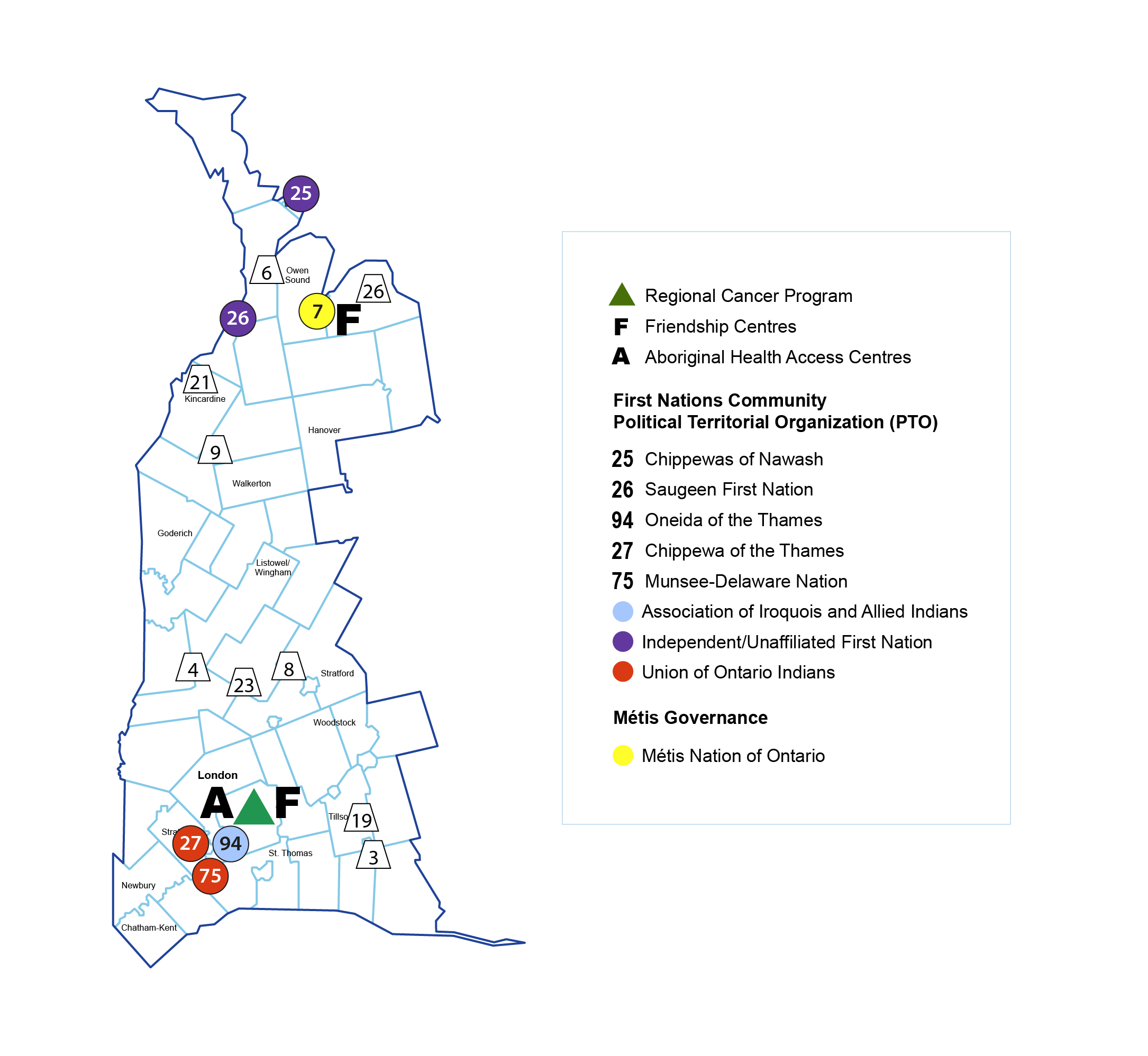
Map Legend:
Map legend:
In the map above, the symbols outlined below represent the location of each service:
- Green square: Regional Care Programs
- Bold and capitalized F: Friendship Centres
- Bold and capitalized A: Aboriginal Health Access Centres
In the map above, the location of each First Nations Community Political Territorial Organizations (PTO) are represented by the following symbols:
- 25: Chippewa of the Thames
- 26: Saugeen First Nation
- 94: Oneida of the Thames
- 27: Chippewa of the Thames
- 75: Munsee-Delaware Nation
- Light blue circle: Association of Iroquois and Allied Indians
- Purpose circle: Independent/Unaffiliates First Nations
- Red Circle: Union of Ontario Indians/Anishinabek
In the map above, the symbol outlined below represents the Métis Nation of Ontario Community Councils:
- Yellow circle: Métis Nation of Ontario
References
Please note the numbering and colouring system corresponds to the South West LHIN map above, which overlays First Nations communities and their Political Territorial Organizational affiliation, Métis Nation of Ontario Councils and the Friendship Centres over the regional boundaries. This map and the provincial map were produced by Cancer Care Ontario (see: Aboriginal Cancer Strategy II (2012), pp.44-45).