The pop-up cervical cancer screening clinic is drop-in – no appointment or referral necessary. It is first-come, first-served.
Please be sure to bring your Ontario health card.
LHSC’s clinic staff will follow up with anyone whose results are abnormal.
Clinic location and details:
When: Friday, June 5, 2026 from 9:00 a.m. to 12:00 p.m.
Where: Victoria Hospital, LHSC. Zone E, third floor, room E3-619.
Please use the door to the left of the main Zone E entrance. You can use MazeMap to map your way to the clinic when onsite.
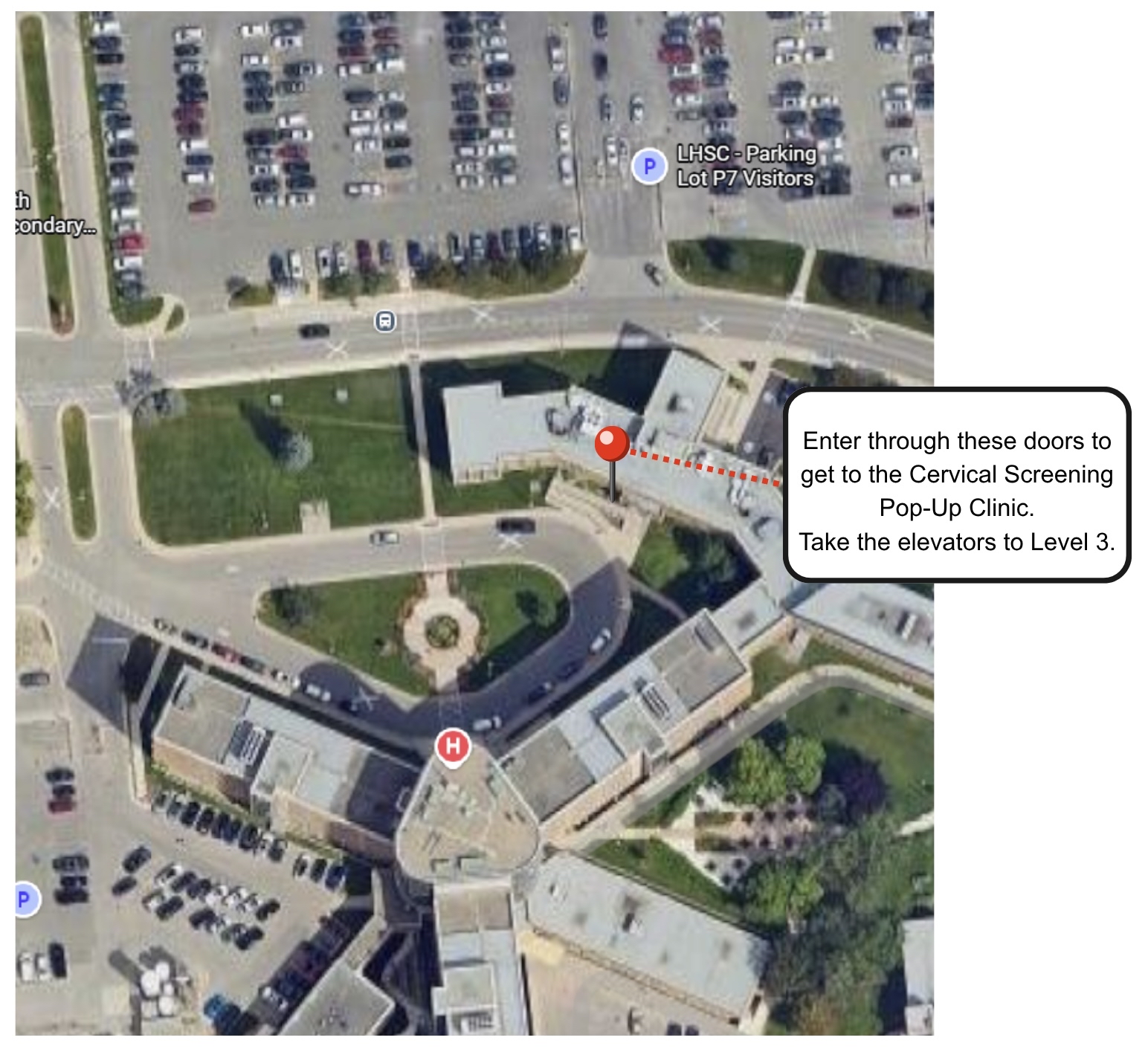
Parking: There is a visitor parking lot 7 that is across from E zone.
Eligibility: Anyone with a cervix age 25 and older who has NOT had a pap test in the past three years. This can include women and transmasculine and non-binary people.
Additional information about the clinic and the cervical screening test
This clinic offers the best in cervical cancer screening with the shift to Ontario’s HPV testing. The difference is in the lab, not the clinic, but it is a better test that you don’t need to take as often. To learn more about the change and how it impacts you, please read below.
What is the cervical screening test:
Previously, it was referred to as a pap test and in March 2025, Ontario Health (Cancer Care Ontario) launched the new cervical screening test that uses human papillomavirus (HPV) testing to better prevent cervical cancer. HPV is the leading cause of cervical cancer.
Most cervical cancers are found in people who have never been screened or who have been screened less often than recommended by Ontario’s cervical screening guidelines.
The exam itself has not changed, and it only takes a few minutes. An instrument called a speculum is inserted into the vagina. The speculum holds the walls of the vagina apart so that the doctor or nurse can easily see the cervix. The doctor or nurse will then take samples of the cervical cells using a soft brush and a flat scraping device called a spatula. The sample cells are sent to a lab to be studied and tested. There may be some discomfort or pressure during the procedure, but it is not usually painful. After the exam, the individual can go about their day as usual, without any restrictions.
What’s different about the new testing
Up until March 2025, a pap test, or pap smear, looked for abnormal cells on the cervix that could possibly lead to cervical cancer. Pap tests could find cell changes caused by high-risk HPV, but they didn’t test for HPV itself.
The new screening process uses advanced molecular techniques to detect types of HPV that can cause cervical cancer as well as cell changes in the cervix caused by these types of HPV. The test does not check for types of HPV that do not cause cervical cancer. With greater accuracy, people can go longer between screenings.
What this means to you
The new cervical screening test will feel like getting a pap test – it’s only the testing in the lab that is changing. As always, a speculum is inserted into the vagina and a small, soft brush is used to take cells from the cervix so the lab can test for cancer-causing types of HPV and cell changes.
With greater test accuracy, however, most people can go longer between screenings – five years instead of three – if everything is normal.
Please note: Some people may need to get screened more often based on their medical or screening history.
For more information: